Thursday, January 05, 2006

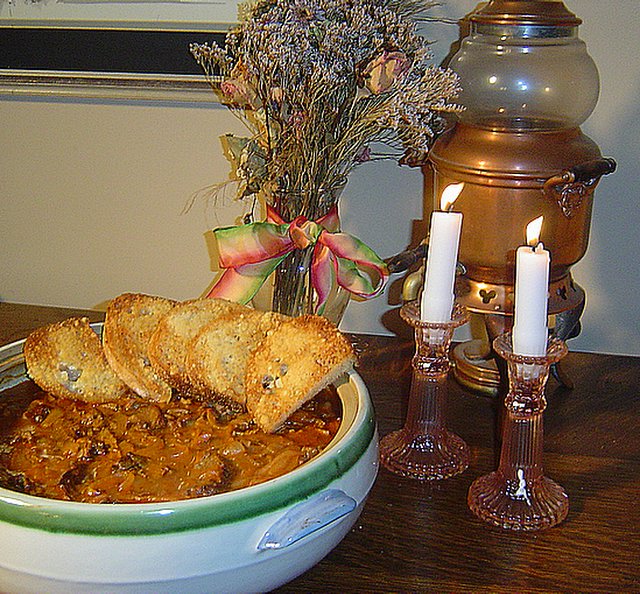
Yummy Chestnut-Scallop Soup

Along about this time every year I get this question: "What can I do with chestnuts besides stuffing?" Chestnuts are widely available this time of year, precooked, in jars or in vacuum packs. They are a versatile food, nutritionally similar to brown rice. In Europe they are used in a variety of breads, vegetable dishes or in rich seasonal desserts. I love them in soups.

Recently I had a pound of dry scallops that needed to be cooked. Scallops as we usually find them in the US are the muscles that hold the shell halves together. Harvested from the Eastern US coast up through the Canadian coast, they come two ways: "wet" or processed, and "dry."

Processed scallops are soaked in a phosphate solution, which has two results: first, it prolongs the shelf life of the scallops; and secondly it causes the scallops to absorb the liquid, plumping them up. When heated, the scallops give up this liquid, making it almost impossible to get them browned before they are disagreeably tough. If you buy frozen scallops, check the bag carefully. You could be paying for water content of up to 30-35%.

Dry scallops, on the other hand, have a shorter shelf life, but, patted dry before cooking, will turn a lovely golden brown well before they are overcooked. Dry scallops must have a moisture content of 20% or less. They are more expensive than wet scallops, but you’re not paying for a lot of water. You can order them from specialty markets, or ask your supermarket seafood counter to order them for you.

So, as I was saying before I started that little lecture, I had a pound of large scallops (U-10, meaning 10 or fewer per pound) that needed to be used. I have made chestnut soups before, but was inspired to try it with the scallops, and was I glad I did! It was very quickly done, and everyone declared it fabulous. I had a loaf of crusty bread and a green salad, and that was all we needed for a great meal for a chilly evening.

You can make the basic soup earlier in the day, or even the day before, and chill. Then at serving time, reheat the soup and the bacon garnish, sear the scallops and bring out the bread and salad. Wouldn’t this be a wonderful way to end a cold winter day?

Creamy Chestnut Soup with Scallops

3 slices good smoked bacon (I used applewood-smoked)
Olive oil, if needed
3 large shallots, peeled and minced
4 cups chicken or vegetable stock
7 to 8 oz cooked chestnuts
1 cup heavy cream
3 tbsp unsalted butter
1 lb sea scallops (see note)
2 tbsp all purpose flour
1 tbsp fresh thyme leaves, plus sprigs for garnish (see note)

Cut the bacon crosswise into 1/4" strips. In a heavy saucepan, cook over medium heat until lightly browned, but not crisp. Remove with a wooden spoon and reserve. Add the shallots. Good bacon doesn’t usually leave a lot of fat in the pan. You may want to add a splash of olive oil. Cook the shallots, stirring occasionally, about 5 minutes. Add the stock, bring to a boil, reduce heat and simmer uncovered for 5 minutes.

Chop half the chestnuts coarsely and add to the soup. Continue to simmer another 5-10 minutes. Puree with a hand blender, or in a food processor. Add the cream and the remaining chestnuts, cut into quarters. Bring to a simmer and keep warm.

In a large heavy skillet over medium high heat, melt the butter. When it is foaming, add the scallops (which have been patted dry) without crowding. Cook until well browned on each side, turning once, 5 to 6 minutes total. They should just barely be done in the center. Remove and keep warm. Reduce the heat to medium and add the flour to the skillet. Stir and cook a couple of minutes, being careful not to brown the flour, scraping up any browned bits with a wooden spoon.

Whisk the flour mixture into the soup, add the thyme leaves, bring to a simmer and cook until thickened, whisking constantly.

Divide the scallops among six flat soup bowls. Ladle the hot soup over the scallops and sprinkle with the bacon strips. Garnish with a sprig of thyme. Serves six as a full meal, or eight as a first course.

NOTE: If you prefer, a pound of boneless chicken breasts, cut into 1" chunks, can be substituted for the scallops.
NOTE: If fresh thyme isn’t available, use 1 teaspoon dried thyme leaves, and garnish the finished soup with minced parsley. I think this would also be excellent with tarragon, too, although I haven’t tried it. I will, though!

Tuesday, January 03, 2006

Pomegranate Pasta-For Wine Blog Wednesday

We are near the end of the very short season for fresh pomegranates. Cultivated since pre-historic times, they seem to be native to the Middle East. They appear in Greek mythology, in the Old Testament, and in ancient Chinese art and literature. And they’ve been cultivated in California for over 200 years.

They have a short season--available from November through January—so now is the time to pick up a few. They are touted as having a high concentration of antioxidants, and to possess heart-healthy properties. The seeds provide a high fiber content, and a considerable amount of potassium and vitamin C. In their native habitat, they’ve been used for centuries in folk medicine, to treat all sort of ailments, including sore throats and rheumatism. But that’s not why we like them…they also taste good!

Don’t be intimidated by their appearance. A pomegranate isn’t exactly a beauty contest winner. About the size of an orange, it has a tough dull reddish skin. But within lies the treasure: hundreds of little seeds surrounded by a delicious sweet-tart ruby red pulp. This is the part used to flavor and color grenadine, or to simmer down into pomegranate syrup (also known as pomegranate molasses).

To extract the seeds, you can simply cut off about ?" of the cap, score down the sides and pull sections apart, loosening the seeds from the bitter membranes with your fingers. A word of advice: Do not do this wearing your favorite white cashmere sweater!


I like to eat the little seeds right from the fruit, or scatter them over a garden salad for a burst of color and flavor. They make a wonderful addition to a winter citrus fruit salad. Sprinkle them over grilled or broiled fish instead of lemon juice. Or you can add them to guacamole or hummus for extra tang and zip.

Right before the last Wine Blog Wednesday, I had bought a couple and was trying to think of something new to do with them. I was making pasta for dinner…and here’s what came of it. It was quickly done, and I thought it was really yummy. A crisp green salad and crusty bread makes it a perfect weekend meal. But don’t wait too long to try it--in another few weeks the season will be over!

FETTUCCINE WITH CHICKEN AND POMEGRANATE
1 lb boneless chicken breast
1/4 cup all purpose flour
1 tsp salt
1/4 tsp pepper
4 tbsp butter
4 shallots, peeled and minced
1 tbsp fresh mint, shredded (see note)
1 tbsp fresh thyme leaves
1 cup dry white wine
1/2 cup heavy cream
Seeds of one pomegranate
12 oz fettuccine
Fresh thyme sprigs for garnish

Cut the chicken breast into 1" chunks. In a flat bowl, combine the flour, salt and pepper. Dredge the chicken chunks in the flour, shaking off the excess. In a large heavy skillet over medium heat, melt the butter. When hot, add the chicken pieces, a few at a time to avoid crowding. Cook until golden on each side. Remove to a bowl and set aside. Add the shallots to the pan and cook, stirring, until tender and translucent, without browning.

Add the wine to the pan and bring to a simmer, scraping up any browned bits with a wooden spoon. Return the chicken to the pan, cover, and simmer 10 minutes. Stir in the cream and ? of the pomegranate seeds. Cook uncovered for another five minutes.

Meanwhile, bring plenty of well-salted water to a boil and cook the fettuccine until just barely al dente. Drain and add to the pan with the hot sauce. Toss well and serve immediately, sprinkled with the remaining pomegranate seeds and topped with a sprig of fresh thyme.

NOTES: If you can’t find fresh mint, leave it out and use 1-1/2 tablespoons of fresh thyme leaves. If you don’t have shallots, you can use about 1/4 cup minced onion with one clove minced garlic instead. I didn’t think it needed grated cheese, but if you think pasta is naked without it, I would suggest pecarino romano as a good choice.

Hello again!

I'm back...the holidays are over! I like to say that my holiday begins when the store closes on New Year's Eve, but then yesterday we had inventory to do. So maybe my holiday starts today.

Anyway, I've done some cooking this past month, and will share it with you over the next few days.

I hope everyone had a wonderful holiday season and wish you all a very happy new year!

Wednesday, December 07, 2005

Wine Blog Wednesday #16

With the challenge by Derrick to choose a wine this month that's just another pretty face, I wandered around the wine shop, discarding first one, then another, until I saw this wine. Isn't that a cute label? I love a winemaker with a sense of humor (the clever wine names from Bonny Doon come to mind). I was hoping for something a little more....shall we say esoteric...than a chardonnay but I just had to have it! And at $6.00 a bottle how much was I risking?

I was making pasta, and picked up a pomegranate at the grocery store. The sauce turned out to be a sort of herbed alfredo with sautéed chicken and pomegranate seeds. (I'll post the recipe when I make it again and get proportions. It was definitely worth making again.)

Some web searching reveals that the winery, Rex Goliath , located in Monterey County, California, makes several varietals under this label, supposedly named after a huge rooster that traveled with a Texas circus in the early 20th century.

We opened the wine and poured it. Our first whiff was not impressive. It seemed a bit short on the bouquet, with dusty overtones, which fortunately blew off after a couple of minutes, leaving a much more pleasant impression to the nose.

We tasted it. A hint of toasted oak, a bit of citrus and maybe apples. A little too acid for my taste at first. But it mellowed out with a few minutes in the glass. The finish, while pleasant, was not lingering. However I must say, the pasta, the creamy sauce and the tartness of the pomegranate seeds really did work well with the wine.

The final comment? I'd give it 8 to10 out of 20 points. Would I buy it again? I think for the price it was far better than I would have expected. I probably will, since it was one of the better inexpensive wines I've tried in a while.

And isn't that an cute label? Posted by Picasa

Thursday, December 01, 2005

"French Leftover Beef"


Posted by Picasa When I was a young bride in Louisville, my husband and I were both school teachers and would occasionally be invited to the home of students for dinner. Since I taught French and he was a Fine Arts teacher, we usually had the kind of student that would allow us to accept: reasonably good students who were reasonably well behaved.

One of the homes we most enjoyed was that of Victor and Harriet Engelhard. They had three sons, all of whom one or the other of us taught. They lived in a real log cabin in the middle of a green woodsy area. Granted, it was a four bedroom, multi-bath home with all the modern conveniences, but the log-walled interior was as warm and welcoming as the hosts.

Mrs. Engelhard is an excellent cook. I have several recipes from her that I still use often. One is for “French Leftover Beef.” a recipe she got from a woman’s magazine years ago. It makes yesterday’s roast or steak worth saving, or as I sometimes do, cooking extra to make this dish. Recently I was left with some leftover roasted beef tenderloin (now that doesn’t happen often, does it?) and decided to make the dish for friends.

As I was getting ready to write about it for you, I was re-reading Elizabeth David’s “An Omelette and a Glass of Wine,” a collection of her newspaper and magazine writings. In it she mentions boeuf miroton, “the time-honored dish of every Frenchwoman who had to deal with…beef leftovers.” Of course I went looking for it in my French cookbooks and in the Larousse Gastronomique, the last word in French cuisine.

I came up with several variations of the recipe; this dish is indeed a version of boeuf miroton. Most of the French recipes call for putting beef slices on an oven-proof dish, covering with the sauce and baking, and none called for sugar, but everything else was present in one version or another. The French usually recommend this for leftovers of pot au feu (boiled beef), but I have used it successfully with roast, braised or even grilled beef.

All you really need to accompany the dish is a big green salad and cheese toasts. Butter slices of French bread, sprinkle generously with Parmesan cheese, dust with paprika, and run under the broiler to brown just before serving. I think your friends will enjoy it as much as mine did…and there won’t be any leftovers!

FRENCH LEFTOVER BEEF

2 onions, thinly sliced
2 tbsp vegetable oil
2 tbsp all purpose flour
1/2 cup dry vermouth (or other dry white wine)
1/2 cup beef stock
2 tbsp tomato paste
1 tsp sweet paprika
1-1/2 tbsp red wine vinegar
1-1/2 tbsp sugar
Salt and pepper to taste
3 cups cooked beef, in 1” chunks or thick strips

Sauté the onions in the oil until golden. Add the flour and stir until lightly browned. Add the remaining ingredients except beef and simmer, covered, for 20 minutes. Add the beef and simmer for 15 minutes more, adding a bit more beef stock if it gets too thick. Serve on a platter surrounded with cheese toasts. Serves 4-6.

Tuesday, November 29, 2005

Splendid Table Soirée

A few weeks ago, WKNO, our local public radio station, brought Lynn Rosetto Kasper to Memphis for a fun filled weekend. If you listen to her weekly show, the Splendid Table, you will be truly jealous to know that I was blessed to play sous-chef to her cooking class at the Viking Center. here in Memphis on Friday, and then on Saturday evening, we did a private, WKNO members only dinner at Mantia's.

If you have ever met "famous" people, you have learned that sometimes they can be distant and condescending...and others are every bit as warm, charming and knowledgeable as you would have thought. Lynn is truly one of the latter. After a few bites of each course, she was up and mingling from table to table, chatting, answering questions, and socializing. As far as the questions go, I listen regularly to her show (and in fact, am an underwriter for her show...which is Public Radio's term for "sponsor"). At the tail end of each show, she invites folks to call in with questions. I had always envisioned her sitting in front of a computer with all the search engines going full blast, and a staff of several sitting around her with tons of resource books. Not so! She fielded some pretty obscure questions with an enormous amout of knowledge...I was impressed and I don't impress easily!

She's written two books, The Splendid Table, which won a number of awards, and The Italian Country Table. Both are delightful to read for the background stories, as well as to cook from. Our dinner came from her cookbooks, and just to let you know what you missed, here is the menu, with the wines, selected by Elizabeth Mall of Delta Wholesale, a house here with a great list of Italian wines:

Aperitivo e Crostini
Little toasts with amusing toppings
Zardetto Prosecco Brut

Antipasti Misti
A plate of tantalizing bites
Cusumano Insolia Sicilia IGT 2004

Fusilloni con Salsa di Porcini con Pomodori
Spiral pasta with Piancenza's Porcini-Tomato Sauce
Cusumano Nero d'Avola Sicilia IGT 2004

Pollo a Due Tempi Il Vecchio Molinetto
Erminia's Pan Crisped Baby Hens
Fagliolini alla Bolognese
Sauteed green beans bolognese
Palladio Chianti DOC 2002

Budino all'Emiliana
Cinnamon and Clove Custards
Vigna Moscoti d'Asti Piemonte 2003 DOC

Saturday, November 12, 2005

More Catfish

I have gotten several e-mails asking for Sonny's catfish cake recipe referenced in my column of a couple of weeks ago, and posted yesterday. Never one to ignore my adoring public (you DO adore me, don't you?) here it is:

SONNY'S CATFISH CAKES

1-1/2 lb catfish filets
4 ounces Sonny Salt
1 each red, yellow and green bell pepper, diced
1 carrot, peeled and shredded
3 green onions, thinly sliced (green and white parts)
1 egg
1 tbsp worchestershire sauce
1 tbsp mayonnaise
1 tbsp Dijon mustard
1 tbsp Sonny Salt
1 pinch ground black pepper
2-3 cups bread crumbs, divided
(can be fresh, or packaged plain crumbs)
Vegetable oil for frying

In a large pot, bring about 4 quarts water and 4 ounces Sonny Salt to a boil. Add the whole catfish filets. Cook 10 minutes, remove from the water, drain and chill.

In a mixing bowl, combine the vegetables and set aside.

In a large mixing bowl, whisk the egg. Add the worchestshire, mayonnaise, mustard, 1 tbsp Sonny Salt and black pepper. Whisk to combine well.

Break up the catfish to the size of lump crabmeat. Fold gently into the egg mixture until well coated. Add 1/2 cup of the veggies and 1/4 cup bread crumbs and fold gently to combine.

Put the remaining breadcrumbs on a baking sheet. Using an ice cream scoop, pick up about 1/2 cup of the mixture. Form into a pattie and put on top of the bread crumbs. Press gently to coat, then turn over and coat the other side.

Heat enough oil in a heavy skillet to come to 1/4" to 1/2" depth. Carefully pick up the patties, brushing off excess crumbs. Cook in the oil for 3-4 minutes per side or until golden brown.

Serve with a green salad and cocktail sauce (catsup, lemon juice, horseradish, tobasco, worchestershire and Sonny Salt, combined to your taste).

NOTE: These can also be made in 1" size, for great appetizers!

Friday, November 11, 2005

Fancy Catfish


Posted by Picasa

As you all know, I am blessed with a cadre of friends who are great cooks. A few weeks ago I went to a catfish feast at the home of Sonny and Ginger Reese. Sonny, who in his "day job" is a manufacturer's representative selling commercial sound and paging systems, is the cook of the family. He also does occasional wedding photography, strictly by word of mouth, almost as a hobby. But food is one of his passions, and he takes every opportunity to cook and entertain friends.

When a house fire a few years ago did considerable damage to the kitchen, it was redesigned with Sonny in mind. The range, sink and cabinets are several inches taller than usual height. Ginger, who teaches English at Lausanne, and is a much shorter person than Sonny, is happy to sit back and let Sonny do it all! The remodeling includes an island that overlooks the cooking area, with tall chairs so guests can sit, chat, watch and share the treats as they come off the stove.

And that evening the treats were flying off the stove! Our first bites were excellent little hush puppies, crisp and brown on the outside, moist and fluffy on the inside. Next we had catfish cakes with a spicy cocktail sauce and grated parmesan cheese for dipping.

Then came a massive platter of fried catfish, with cole slaw and fries. And finally, when we all thought we couldn't possible eat more, a wonderful catfish meuniere, Creole style, with a zesty pecan butter sauce. Every dish was seasoned with "Sonny Salt." This is a unique blend of seasonings, which he created and has recently started having packaged to sell commercially. He uses it pretty much anytime a recipe calls for salt.

And we still weren't finished: for dessert we had a great lemon pie with just the right sharp citrus taste to top off such an abundance of food!

I had such a hard time trying to decide which dish to share with you...but the final dish of the evening was so tasty that I thought that this is the one you would most like to recreate. It looks like a long recipe, but some of it can be done ahead. And all it needs is a crisp green salad on the side. Give it a try!

SONNY’S CATFISH MEUNIERE

Pecan butter:
3 tbsp soft butter
2 tbsp roasted pecans
3 tbsp lemon juice

Meuniere sauce:
2 tbsp all purpose flour
2 tbsp water
1/2 cup Worcestershire sauce
1/2 cup seafood or chicken stock
3 tbsp lemon juice
1 cup butter

Catfish:
6 catfish filets, about 6 ounces each
3 tbsp Sonny Salt*
2 cups all purpose flour
2 eggs
1 cup milk
1 cup butter
8 ounces roasted pecans

Make the pecan butter: place all ingredients into a food processor and process to a smooth puree. Set aside.

Make the meuniere sauce: Combine flour and water to a smooth paste. Set aside. In a saucepan, bring stock, Worcestershire sauce and lemon juice to a boil. With a wire whisk, beat some of the hot stock mixture into the flour paste. Then gradually pour the flour mixture back into the stock, whisking constantly. Simmer briefly, then whisk the butter in a tablespoon at a time.

For the fish, sprinkle the filets with two tablespoons of Sonny Salt. Set aside. In a pie plate, beat eggs with milk. In another, mix the flour with the remaining Sonny Salt. Dip filets first in flour, then in the egg mixture, then in the flour mixture again and set aside on a baking sheet.

In a large skillet, heat half the butter over medium heat. Add half the catfish and cook 3-4 minutes, or until golden brown, turning once. Transfer to warmed serving platter and cook remaining filets.

To serve, spread the pecan butter evenly over the filets and sprinkle with the pecans. Warm the meuni?re sauce and pour over the top. Serve immediately. Serves 6.

NOTE: Sonny Salt is available locally in several specialty markets, including Mantia's. If you aren't in the Memphis area, use a good brand of seasoning salt, or e-mail us and we'll send it to you!

Thursday, November 10, 2005

Entertaining meme...

Without a doubt this is my most indispensable entertaining item. I have lots of plate, platters, bowls, silver and pewter serving pieces, and sets of dishes to serve a cast of millions (well, perhaps I exagerate there...).

But what I love the most is a flower pot, made not of clay but of some sort of sort of foamy plastic, so it doesn't weigh a ton. I can fill it up with wine and ice--it will hold four or five bottles of wine--and first, IT DOESN'T SWEAT! So I can put it on almost any surface without worrying about water spots or white rings. Secondly, it makes for good insulation, and if I fill it up with wine and ice, the ice will be there long after the wine is gone, so I don't have to worry about keeping the wine cold.

I got three of these at Sam's Wholesale Club a couple of years ago and if memory serves, I paid around $8 each. One of my best investments!

Tagged with: +


Posted by Picasa

Warming lamb soup...


If you're a regular reader you know that since my accident, I've been peering into my freezer frequently to see what's hidden in there. And I've found some great forgotten goodies. This week I found a solitary lone lamb shank. Why would I do that, do you think? I mean, if I were cooking for guests and had one extra, wouldn't I have cooked that one to be sure of leftovers? Surely I didn't buy just one... It's a mystery.

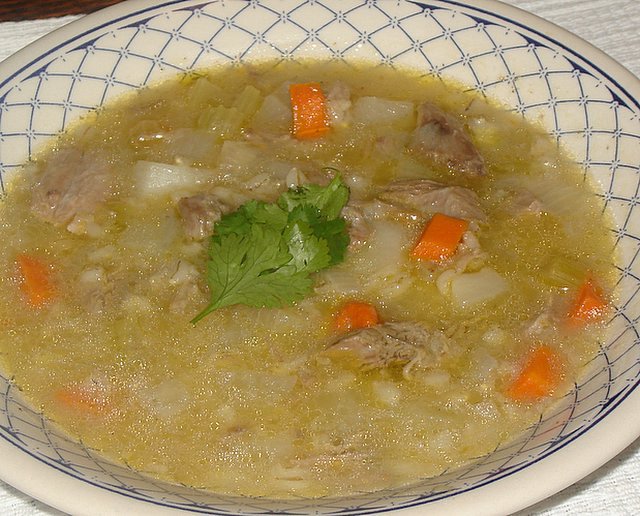
Anyway, even though the weather here in Memphis is unseasonably warm for November--we set a record on Tuesday with a high of 86 F--I made soup. I've had Scotch Broth a few times but had never made it. I will certainly do it again! And if the weather had been chilly and damp it would have been even better. It may not look "pretty" but it sure was tasty. And as is true for many great soups, it is equally good the next day!

SCOTCH BROTH

1 leek
2 tbsp butter
1 large lamb shank, or 1 lb lamb breast, shoulder or stew meat
1/2 cup medium grain barley
Water, as needed
2 medium turnips
2 carrots
4 stalks celery
1 medium onion
Salt and pepper to taste

Trim off the tough green tops and the root end of the leek. Cut the remaining white and pale green part in half lengthwise, then crosswise into 1/2" slices. Melt the butter in a large heavy pot and cook the leek over medium heat, stirring occasionally, until soft, about 5 minutes. Put the lamb into the pot, just cover with water and bring to a boil. Reduce heat, cover partially and simmer, skimming as needed, for 30 minutes. Add barley and cook for 45 minutes more, or until the lamb is very tender, adding water just as needed to keep lamb barely covered. Taste and season with salt and freshly ground black pepper. Remove the lamb, let cool slightly and remove from the bones in chunks. Discard bones and return the lamb to the pot.

Peel the turnips, carrots and onion and dice. Cut the celery into 1/4" slices. Add the veggies to the pot and simmer until tender, another 20-30 minutes. The lamb shank wasn't very fatty, but if you have too much fat, you can skim off the excess. Serves 6-8. Posted by Picasa