Showing posts with label Spanish. Show all posts

Wednesday, May 07, 2014

Yummy Spanish Pork Tenderloin

               I think I’ve told you that upon the retirement of my husband at the beginning of September, we spent some time visiting our favorite parts of France. One of my much-loved areas is the South of France, and one of my favorite towns there is Aix-en-Provence.
                One evening we wandered into a nice little square that had several cafés and open air restaurants. After a leisurely apéritif in one of the cafés, we chose a restaurant for dinner, Tapas Café (www.tapascafe.com). As you might guess, it features the small plates of Spain. We ordered an assortment of goodies and sat and enjoyed our selections, which came one or two at a time, as they were ready.  One of the dishes was an evening special, “Lomo de Cerdo con Chorizo a la Parilla.”  It was a pork tenderloin that had been stuffed with diced chorizo, rubbed with the smoked paprika of Spain, skewered to keep it closed, and grilled. Served with a sauce of red bell pepper, it was my favorite plate of the evening.


            Recently I thought I’d like to try something similar but the weather didn’t cooperate. It was too windy and rainy to grill.  No problem. I could easily do it in the oven.
Then I went shopping for Spanish chorizo. It’s a dried sausage, like a salami, unlike Mexican chorizo, which is a fresh sausage needing to be cooked.  I found it, but it was expensive. Enough to make this dish would have been around $12.  Pepperoni is similar enough in taste and texture for a dish of this sort. You can go to the deli counter of almost any market and ask for sandwich pepperoni.  Have it sliced a bit less than ¼-inch thick and dice it.
                So, a few recipe changes, a rice pilaf and a green veggie, and we had a lovely dinner for friends. All we needed was the weather and ambiance of the South of France!
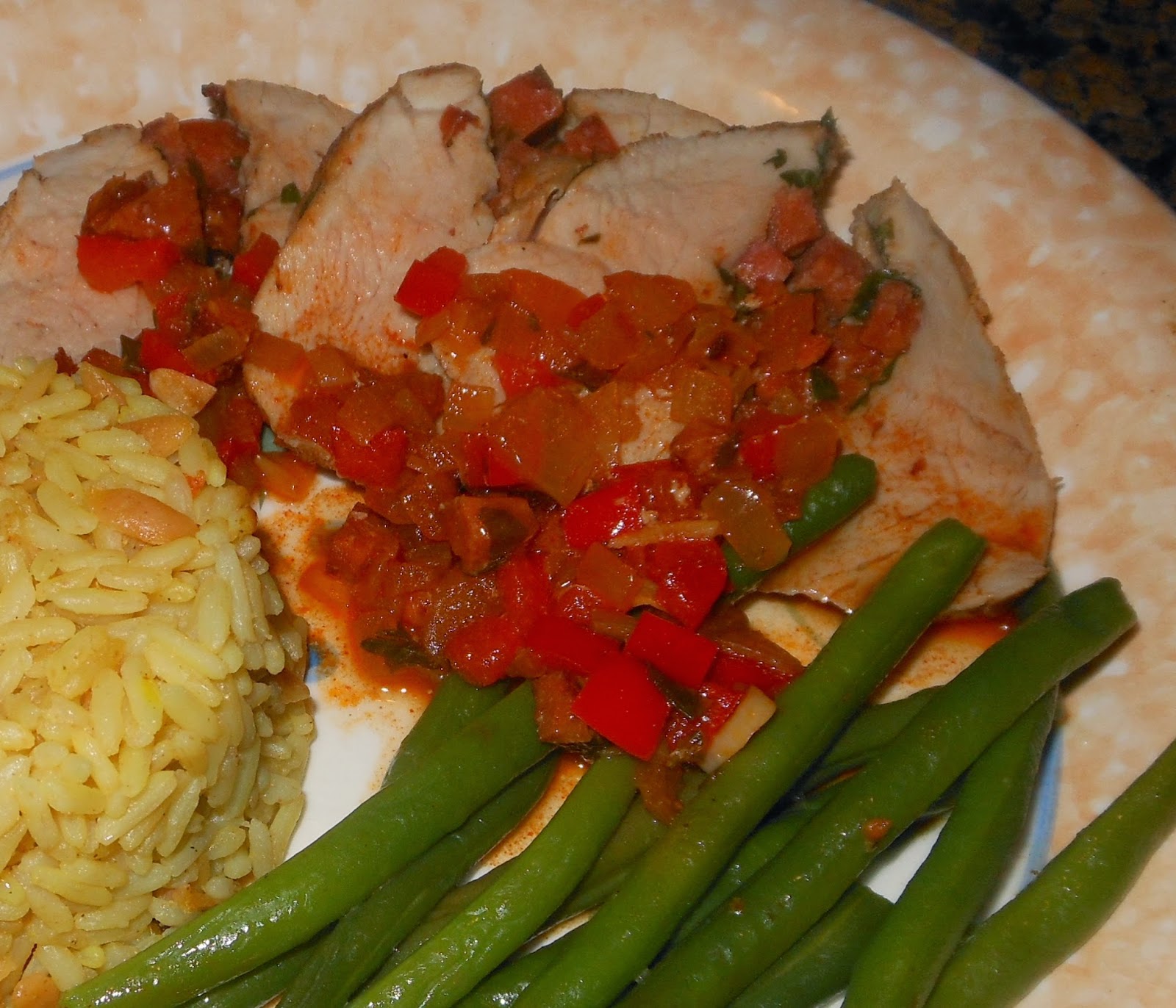


Spanish-Inspired Pepperoni-Stuffed Pork Tenderloin

 2 pork tenderloins (total 2 ½ to 3 pounds)
5-6 ounces sandwich pepperoni
¼ cup good fruity extra virgin olive oil
½ cup chopped flat-leaf parsley
¾ cup diced onion
½ cup diced red bell pepper
2 cloves garlic, minced
2 teaspoon Spanish smoked paprika
1 cup dry white wine

                Preheat the oven to 400o.  Trim the silverskin from the pork tenderloin and cut the tenderloin almost in half lengthwise, being careful not to cut it all the way through.  Set aside.
                If there is a casing on the outside of the pepperoni, remove it.  Cut into cubes a bare ¼-inch across. In a heavy skillet, heat the olive oil over low heat. Add the pepperoni cubes and cook, stirring occasionally, until they have rendered their fat and are crispy, about ten minutes.  Remove from the pan with a slotted spoon, leaving as much of the oil as possible in the pan. Let them drain on a paper towel.
When cooled, place them in a bowl with the parsley and toss to mix.  Sprinkle the inside of the pork with salt and pepper.  Stuff with the pepperoni mixture.  Tie at about 1 ½ inch intervals to close.  
In the fat remaining in the pan, brown the pork on all sides, especially the top.  Place in a baking dish.  In the same pan, cook the onion, bell pepper and garlic until soft but not browned.  Add the smoked paprika and cook, stirring, for a couple of minutes. Scrape into the baking dish, surrounding the pork tenderloins. 
Deglaze the pan with the white wine, scraping up any browned bits on the bottom. Pour over the pork.  Place in the oven and roast until a meat thermometer reads 145o. This will probably take 20-30 minutes but start checking after 15 minutes. You may want to cook it longer, but 145o is high enough health-wise and gives you very moist and tender pork that is still a bit pink inside. Let the pork rest about five minutes, then slice, plate, and drizzle the pan sauce over each serving. Serves 6-8. 


Wednesday, June 27, 2012

A Better Burger: Spanish-Inspired Pork Burger


                 Neighbors were coming for a casual supper recently, and I wanted to grill.  Everyone likes hamburgers but I wanted something a little different.  I had just done a well-loved Spanish-style marinated pork tenderloin for the rehearsal dinner of a friend’s son and wondered why I couldn’t put the same spices into a pork burger.
                I used manchego, a Spanish sheep-milk cheese, to top the burgers. It has a brown wax coating that I trimmed off so the cheese could be thinly sliced.  It’s pretty widely available but Swiss cheese would make a good substitute.
                The sauce I serve with the pork tenderloin, a sherry aioli, is easy to make and still delicious if you prefer to omit the sherry.  I usually use an oloroso sherry because I like the full flavor and sweetness it lends. .  But any kind of sherry will work, except for the oversalted cooking sherry available in grocery stores.
                Spanish smoked paprika is a wonderful spice, available in most supermarkets and at Penzeys. I prefer the sweet (not hot) variety, but if you like more spice, the hot one would also be good.
                I added a slice of red bell pepper and a crisp lettuce leaf to each burger, put it on an onion roll and the guests pronounced it perfectly delicious.
                  Typically I roast the pork tenderloin on a bed of potatoes, so oven-roasted potatoes were the side dish the first time I made these. I thinned a spoonful of the spice mixture with additional olive oil and tossed them in it before roasting. The burger was so tasty that I made them again and this time I spread butter mixed with lime zest on fresh corn-on-the-cob, wrapped them in foil, and roasted them on the grill as the burgers cooked. That made quite a lovely companion dish as well.

SPANISH ADOBO-SPICED PORK BURGERS

Sauce:
½ cup mayonnaise
2 cloves garlic, very finely minced
1 tsp. Dijon mustard
2 tbsp. sherry wine
Burgers:
4 cloves garlic
1 tbsp. salt
2 tbsp. Spanish sweet smoked paprika
1 tsp. dried oregano
1 tbsp. olive oil
1 3/4 lbs. ground pork
To finish:
6 onion rolls (or other burger buns)
6 crisp lettuce leaves
About 5 oz. manchego cheese, trimmed and thinly sliced
2 red bell peppers


                Mix all sauce ingredients together and refrigerate until ready to serve.
                Drop the garlic, one clove at a time, into a food processor with the motor running. When chopped, stop the motor, add the remaining ingredients and pulse until well combined. Scrape down the sides a couple of times. It will make a grainy paste. Add the paste to the pork, mix well and form four burgers. Chill until ready to cook.
                Slice the top off the pepper and scoop out the seeds and membranes. Cut crosswise into ¼” thick rings.
                At dinner time, cook the burgers over medium-hot coals until just done through, about five minutes on the first side, and two to three minutes on the second.   Internal temperature should be around 150-degrees.
                Put the lettuce on the roll bottom, top with the burger, then the cheese and pepper ring. Drizzle with the sauce and enjoy!  Serves six.
Posted by Picasa

Monday, June 20, 2011

Fabulous white sangria!


I’m in a wine dinner group that meets monthly. The host picks the theme and makes the main course and each guest couple signs up for a different course, along the same theme. Sometimes it’s based on one kind of wine, but usually it’s geographic.

Everyone in the group loves to cook and does it well so we have some stellar dinners. Recently it was our turn to host, and I picked Spain as our wine region.

Once again, every single course was exceptional. In fact, over the next few weeks, I’m going to share several of the recipes we enjoyed.

Our first course appetizer was served with white sangria made by Commercial Appeal Food Editor, Jennifer Biggs. It was, with no competition, the best white sangria I’ve ever had (and with my age and travels, I’ve had a few). And it looked absolutely beautiful in the clear glass pitcher, with berries on the bottom, citrus slices and fresh mint.

The secret ingredient was one we all had a little trouble identifying: fresh tarragon. Who would have thought? It was subtle but made all the difference in the flavor. Don’t be tempted to leave it out.

You can make your infused lemonade ahead of time and chill all the components to be assembled when you’re ready to serve it. Have an iced tea spoon ready so you can scoop out a blackberry or two for each glass, pour, and enjoy!

JENNIFER’S WHITE SANGRIA

16 oz good lemonade (see note)
1 handful fresh mint
1/2 handful fresh tarragon
1 750ml bottle dry white wine
8 oz. grapefruit soda (see note)
1 cup Cointreau or triple sec
Fruit:
1 orange, sliced
1 lemon, sliced
1 lime, sliced
Blackberries or other berries
Handful of mint sprigs for garnish

Bring the lemonade to a boil and add the mint and tarragon. Remove from the heat and allow to infuse at least 15 minutes. Discard the herbs and allow the syrup to cool. Put the wine in a pitcher, then add the herbed lemonade, grapefruit soda and Cointreau. Refrigerate at least 1 hour.

To serve, place fruit, berries and mint garnish in the serving pitcher, add ice, and pour in the sangria. Add more grapefruit soda or Sprite if you want a bit of fizz. Makes 8 to 10 five-ounce servings.

NOTE: Jennifer used a bottled not-from-concentrate lemonade available in the juice section of the supermarket. For the grapefruit soda she used Ting, available from the Winchester Road Farmers Market, or in the international aisle of some supermarkets. Fresca or Squirt would also work, but would be less sharp.

Posted by Picasa

Friday, March 26, 2010

Basque Shrimp: A Swimming Success!


A couple of weeks ago, my husband and I went to visit his mother in Philadelphia, PA.  When we are up there, we try to find restaurants with cuisines not available in Memphis.  One evening we googled "tapas restaurant Philadelphia," and at random picked the closest to our hotel, Tinto.  As it turns out, it is owned by the newest American Iron Chef, Jose Garces.  What luck!

We had a wonderful meal of Spanish Basque area small plates.  One of the dishes we most enjoyed was "Lobster with Grapefruit-Vanilla Nage."   Garnished with Spanish smoked paprika croutons (called, in Spanish, "migas"),  it was delicious.

The French culinary term à la nage means "in the swim."  It refers to food, usually seafood, poached in a quickly simmered vegetable broth. called court bouillon, which means "short boil."   It is usually acidulated with vinegar, but at Tinto, grapefruit juice was used instead.  I didn’t think we’d all want to cook up a lobster, but I was pretty sure it would work with shrimp.

 Often in French cuisine the vegetables are served with the broth.  Although it wasn’t done at Tinto, when I served up my third and most successful attempt to my wine dinner group, I did serve the vegetables.

At the wine dinner we had it as a seated first course, but with addition of side dishes of rice pilaf and a salad it would make a light but tasty dinner.

Although it doesn’t take long to do, you can make the broth ahead of time and refrigerate for several days.  Bring up to a simmer for a few minutes before you poach the shrimp.

SHRIMP IN GRAPEFRUIT-VANILLA NAGE

Stock:
2 quarts vegetable stock (see note)
½ head of celery, including leafy greens, cut into 1" pieces, about 2 cups
1 bulb fennel, white and light green parts, sliced ¼" thick, reserving green lacy top for garnish
8 oz baby carrots (half a 1 lb. bag)
2 cups fresh grapefruit juice (must be fresh, not frozen or canned—trust me on this)
1 cup dry white wine
1 tsp. fennel seed, crushed
4 or 5 sprigs fresh thyme
4 bay leaves
1 tbsp. mixed whole peppercorns

To finish:

½ tsp. pure vanilla extract
1-1/2 lb. peeled and deveined shrimp (I used 16-20 per pound size)
4 oz. butter, at room temperature
2 tbsp. heavy cream
1 cup ready made large garlic croutons
1 tbsp. Spanish smoked paprika

Place all the stock ingredients in a non-reactive pan and simmer for 30 to 45 minutes.  Remove bay leaves and thyme stems.
    When ready to serve, add the vanilla and bring to a simmer.  Add the shrimp and simmer until just barely done, depending on the size of the shrimp.
    With a slotted spoon divide the shrimp and vegetables among 8 warm flat soup plates.  To the broth, add the butter and cream.  For best results, use an immersion blender to emulsify the broth with the butter and cream.  If you don’t have an immersion blender, whisk vigorously until well blended.  Even if it doesn’t emulsify totally, it will still be delicious.
In a small bowl, toss the croutons with the smoked paprika.  Ladle hot broth over the shrimp and vegetables, garnish with the croutons and reserved fennel fronds and serve immediately. Serves 8 as a first course, or 4 to 6 as a main course with side dishes.

NOTE:  I use Better Than Bouillon stock pastes, available at most supermarkets, for my vegetable stock.  You can use vegetable bouillon cubes or packaged vegetable stock.  But the BTB will be far better!

Posted by Picasa

Tuesday, November 18, 2008

Spanish Shrimp and Pear Salad

 
Posted by Picasa
I cooked dinner for neighbors of my gentleman friend this week and made a lovely Latino beef stew that will be featured in my Weekend Entertaining column of the Commercial Appeal this Friday. When it is published, I'll add a link to it. It was really easy and truly delicious.

I started the dinner with a Spanish style salad that everyone seemed to enjoy, so I thought I'd share it here. I'd had a salad similar to this in Spain a few years back, made with fresh juicy ripe pears. Since it's not always easy to find juicy ripe pears, I've made it with good quality canned pears with success, which saves a lot of time.

The salad dressing can be used on all sorts of salads, but goes particularly well with the shrimp and pears of this recipe.

SPANISH SHRIMP AND PEAR SALAD

Dressing:
1/2 cup mayonnaise
2 green onions, with some of the green top
2 tablespoons fresh parsley
1 clove garlic, minced
4 anchovy filets
Juice and finely grated zest of one large lime
2 teaspoons dried tarragon, or 1 teaspoon fresh

To finish:
4 handfuls salad greens (romaine or bibb work well)
12 cooked, peeled and deveined shrimp, chilled
1 16-ounce can good quality pear halves, drained
A few black olives

Put all the dressing ingredients in a blender or food processor and puree well. Pour into an airtight container and chill until ready to use.

When ready to serve, divide the greens among four salad plates, top with the pears, then the shrimp. Drizzle with the dressing and scatter the olives around for garnish. Serves 4.

Friday, July 06, 2007

Spain in Louisville

I just returned from a week in Louisville, as many of you know. Although the reason for the trip, my father´s illness, wasn´t the most felicitous, my sister and I were able to visit a couple of new restaurants that we really enjoyed.

The first, was Mojito, a restaurant near my parents´home. We went with our nephew and a couple of his friends. After a fairly brief wait at the bar, where I enjoyed a very good red wine sangria (and my sister didn't particularly enjoy her white wine sangria) we were escorted to a table outside.

The menu is nicely geared toward authentic Spanish, with only a little of the Mexican influence often seen in purportedly Spanish restaurants. There was an extensive selection of tapas, both "caliente" (hot) and "frias" (cold). Our waiter, Ivan (pronounced ee-von) guided us toward some of his favorites. We started with the guacamole (there's that Mexican influence showing up!). It was beautifully presented, with fresh, hot, crisp plaintain chips instead of the more usual tortilla chips. And it was gussied up with finely diced tomato and red onion, roasted poblano chiles and plenty of lime juice. Generously sprinkled with minced cilantro, it could not have been better.


I'm a sucker for mussels and pretty much order them any time they're available. Mojito's version was an excellent if fairly standard presentation: diced tomato, white wine, sofrito (sauteed onion and bell pepper), and garlic, again sprinkled with minced cilantro. With plenty of crisp baguette toasts, and a banana leaf scoop, we had no complaints.


A platter of perfectly done calamari, crisp with a cornflour crust, with a tangy lime-avocado aioli, and the albondigas, spicy little meatballs in a red wine-tomato sauce, somehow got consumed before I could whip out my camera, but we did enjoy the grilled vegetable "tabla." Served on a cutting board, it was colorful with red and yellow baby tomatoes, caper berries, grilled eggplant, yellow squash, zucchini, red onion, green and red bell pepper and whole garlic cloves. Topped with a saffron garlic butter drizzle, I could have eaten the whole thing by myself.


We finished the meal with two desserts to share. One, strawberry shortcake, was a slice of rich pound cake, drizzled with rum and topped with caramelized strawberries, and what I think was a drizzle of reduced sherry wine vinegar, and a scoop of super rich vanilla ice cream.

Possibly the most interesting dish of the evening, however, was their flan, normally a custard with a caramelized sugar topping. This one had the additional tang of goat cheese. Sounds odd? Truly delicious!

Mojito has a well-chosen wine list, reasonably priced, and a good selection of beer, both domestic and imported. The menu is quite reasonably priced, too: the total cost of all the food was under $50. (The wine and beer tab was something else again!)

In in addition to the tapas menu, there is a list of main courses, salads and sandwiches. And what looked to be an excellent paella is available for two or four persons, Valencia style with chicken, Spanish chorizo, grouper, shrimp, mussels and the requisite vegetables, saffron and wine. A bargain, at $15.99 per person (with a 30-45 minutes preparation time, giving plenty of time to enjoy a couple of tapas and a glass of sangria!). Can't wait to try it next time!
Posted by Picasa

Saturday, May 12, 2007

Spanish Tortilla al Chorizo

I’ve had several folks ask for “hands-on” classes at the shop, giving each participant a chance to master a skill that might not be easily demonstrated to a group.

The first class I did was a sausage-making class. We made three sausages, stuffed casings, cooked them and had an accompaniment to each. It was a lot of work, but the results were well worth it.

One of the sausages we made was a Spanish style chorizo. For this one, since a coarse grind was important, we ground the meat ourselves with our handy Kitchen-Aid attachment. The seasonings are very different from the Mexican style hot and spicy chorizo. One important ingredient is Pimentón de la Vera, a sort of paprika from central Spain. The peppers used in making it are not dried in the traditional way, in the sun, but smoked slowly for several weeks over an oak fire. It is a wonderful seasoning. Just a touch gives great flavors to leafy greens, beans, rice dishes, fish and pork.

At any rate, the sausage we made using the Pimentón was a huge hit, and we had some left over. I stuck it in the freezer, thinking I would stuff it into casings another time. But I bet you know me well enough by now to know that just didn’t happen!

I had neighbors coming for a Sunday evening supper. There wasn’t enough of the chorizo to serve as sausage but just enough to make a sort of Spanish tortilla. (“Tortilla” is the Spanish word for omelet, as opposed to the Mexican flour tortilla.) Served with a green salad, it was declared quite tasty by all. This would be a perfect brunch dish, too. It can be baked, not done on top of the stove and can be served either hot from the oven, or at room temperature; or you can make it ahead and reheat it.

So, first I am going to give you the recipe for the sausage. You might not want to grind your own pork, but if you do, use something with plenty of fat, like shoulder or Boston butt. Otherwise, call ahead and ask your butcher to grind it for you in “chili grind,” that is, coarsely, and only once through the grinder. And I bet you’re not going to stuff it in casings, either, but you can use it as sausage patties or meatballs. Then use the rest for the Tortilla al Chorizo.

SPANISH CHORIZO SAUSAGE

2 lb coarsely ground pork, with some fat
1 tbsp kosher salt
1 tbsp brown sugar
2 or 3 cloves garlic, very finely minced
¾ tsp freshly ground nutmeg
2 tbsp sweet Pimentón de la Vera (available in specialty markets)
1 good pinch hot pepper flakes (optional, if you’d like a little heat)

Combine all ingredients. Place in a non-reactive bowl, and refrigerate overnight, covered tightly.
NOTE: Casings are available in small packages from Charlie’s Meat Market. They will also do the pork in the appropriate grind with advance notice.

TORTILLA DE CHORIZO

½ lb chorizo (or Italian sausage)
2 tbsp olive oil, as needed
1 bunch green onions, thinly sliced, with some of the green
¼ cup finely minced white onion
6 oz spinach, coarsely chopped
7 eggs
1 cup finely shredded mozzarella
1 tsp Italian spices or basil, dried, crumbled
1 tsp kosher salt
½ tsp freshly ground black pepper

Preheat the oven to 350o. In a skillet, cook and crumble the sausage just until no longer pink. Transfer to a bowl with a slotted spoon. If there isn’t enough fat left to sauté the onions, add enough olive oil to just film the bottom of the pan. Add the onions and cook, stirring, for a few minutes, or until wilted. Add the spinach and stir and toss until the spinach is wilted.

Meanwhile, spray a 10” pie or quiche pan with cooking spray. The sausage will have given off a bit more liquid. Transfer the sausage to the quiche pan with a slotted spoon. Add the liquid remaining in the sausage bowl to the onion-spinach mixture and cook for another minute. Then spread the onion-spinach mixture evenly over the sausage.

In a bowl, whisk the eggs with a splash of cold water. Add the cheese and seasonings and whisk until well blended. Pour evenly over the contents of the quiche pan. Bake for 25-30 minutes, until the center is set. Cut into six wedges and serve immediately, or reserve and serve at warm room temperature.
Posted by Picasa

Technorati Tags:, , , ,
Generated By Technorati Tag Generator

Friday, March 23, 2007

A Paella Party for the Masses!

When it comes to learning new styles of cuisine, Larry and Mimmye Goode go all out. When they first got a time-share apartment in the New Orleans French Quarter, they went to classes to master the art of gumbo, oyster-artichoke soup and other Creole specialties.

A friend in New York introduced them to Thai food years before Thai was cool in Memphis. They sought out Thai restaurants in New York and New Orleans, and I was with them in London when, one chilly, night, we wandered through the rain and mist looking for a highly recommended Thai restaurant. Then they made several trips to Thailand, taking cooking classes in Chiang Mai.

In another phase, a brush with Indonesian food took them to Ubud, in Bali, for classes in the guest house of a prominent cookbook writer; they’re going back there later this year.

So it came as little surprise to their friends when, after reading that the best paella in Spain is prepared over a wood, fire, Larry dug a pit in the side yard of their East Memphis home, lined it with stone, put a grate on it and invited everyone to help.


Over the years this has become an annual affair. The guests, this year numbering more than 30, bring an appetizer or dessert and a bottle of wine, and mingle while the paella cooks.

There are stories: the year it rained and umbrellas were held over the fire pit until the paella was done; the year the firemen came after a neighbor saw the smoke and called them.

Two kinds of paella are made, one of all seafood to accommodate the non-meat eaters in the crowd, and another of the traditional sort, with chicken, shrimp, shellfish and chorizo.

Why not give it a try? You probably aren’t going to dig a hole in your yard, but you can use a gas or charcoal grill; toss on some wood chips for a good smoky flavor. It can also be prepared on top of the stove with excellent results.

If you’d like to include the seafood paella, just follow the directions, leaving out the chicken and chorizo, and using seafood stock as your liquid.

Get all your prep work done ahead, invite a few friends, who’ll supply the appetizers and desserts, and make your paella when they get there. Who knows? You might start your own tradition!

PAELLA VALENCIANA

3 tbsp good fruity olive oil
1 small chicken, bone-in, cut into serving pieces
2-3 cloves garlic (more can’t hurt), minced
1 large onion, chopped
1 lb paella, arborio or carnaroli rice (see note)
6-8 cups chicken stock
1 tsp (loosely packed) saffron threads
1 lb medium shrimp, peeled and deveined
2 lb each fresh mussels and fresh clams, scrubbed
4 oz sweet Spanish chorizo sausage, or pepperoni, thinly sliced
1 10-oz package frozen peas, thawed
1 red bell pepper, in julienne strips
1 yellow bell pepper, in julienne strips

In a paella pan or heavy 12” skillet, heat the olive oil over medium heat. Sauté the chicken without crowding, turning a couple of times, until the skin is golden brown and crispy. Remove to a plate and reserve. Add the garlic, stir a couple of times, then add the onion. Cook, stirring frequently, until the onion is tender and lightly browned. Add the rice and stir until coated with the onion/garlic/oil mixture. Nestle the chicken pieces in the rice.
Meanwhile, bring the stock to a boil, add the saffron and reduce the heat to simmer.
If you’re using a grill, preheat it and put the pan over the hottest part. Add the stock by ladlefuls, waiting until most of it is absorbed before adding more. After about 10 minutes, add the chorizo and shrimp, pushing down into the rice mixture. Gently mix in the peas. Then put in the clams and mussels, hinge side down. Continue adding stock until the rice is almost tender. Scatter the peppers on top and cook until the shell fish are open (discard any that don’t) and the rice is tender but still firm in the center. The consistency of the paella should be very moist but not soupy. You can serve this immediately, but often in Spain it is served almost at room temperature. Serves 10-12.

NOTE: These specialty short grain rices are available in gourmet markets and some supermarkets.
Posted by Picasa