Wednesday, August 08, 2007

French Summer Picnic Sandwich


In my much younger days, I spent several summers at the University of Montpellier in the south of France. After morning classes, we would all grab a towel and a bathing suit and take a tiny quaint little train out to the beach at Palavas-les-Flots.

Our first stop would be one of the little stands along the beach selling “real” French fries. Piled up and already par-cooked, they would be thrown into a tub of boiling oil and emerge perfectly crispy. A sprinkle of salt and a twist in piece of waxed paper and we’d be on our way to the next little stand, selling drinks and “pan bagnat.”

This sandwich was a staple of ours. The name means “bathed bread,” or “wet bread.” Crusty French bread rounds would be cut in half, a little of the bread pulled out to make room for the filling and wrapped. Then trays would be set on top and weighted, to allow the juices from the tomato, the oil from the tuna, and a bit of vinaigrette to seep into the bread and the rest of the filling.

So when we planned a cooking class titled “Picnic in Provence,” this was the first thing that popped into my mind. We accompanied it with a salad of haricots verts, the tiny French green beans, tossed in a zesty vinaigrette and sprinkled with shaved red onion and fresh basil. Fresh beans from the farmer’s market would be lovely. Just be sure not to overcook them. They should be just barely crisp-tender.

You can make the sandwich on large crusty rounds, as we did, and cut it into wedges, or on smaller individual crusty rolls if you can find them. A regular sandwich bun or roll would get too soggy to work here.

This is a sandwich that definitely needs to be made ahead for the best flavor, making it perfect for a picnic. If you make the salad, don’t put the dressing on until shortly before serving. It wouldn’t affect the flavor, but the vinaigrette makes the bright green beans a sort of olive drab color after a bit.

So gather a few friends and head out to the park with a perfect French picnic!

PAN PAGNAT

1 tablespoon red wine vinegar
1 teaspoon Dijon mustard
1/4 teaspoon each salt and freshly ground black pepper
1/4 cup good fruity olive oil
1 large crusty bread round
1 can (6 to 7 ounces) tuna packed in olive oil
1 green pepper, cut into very thin strips
1 small red onion, very thinly sliced
2 eggs, hard-cooked and sliced
1 tablespoon capers, drained
1/4 cup sliced black olives
1 large red ripe tomato, thickly sliced
4 anchovy filets (optional, if you hate them)
1 large handful arugula or baby greens

In a small bowl, whisk together the vinegar, mustard, salt and pepper. Whisk in the olive oil until emulsified. Set aside.

Cut the bread in half horizontally and scoop out some of the insides. Brush the bottom with a bit of the dressing. Layer ingredients as listed, drizzling the remaining dressing on top of it all. Place the top on the bread and wrap tightly in foil or plastic wrap.

Traditionally, this is weighted—a cookie sheet with a couple of cans on it will work well—f or a couple of hours, and not refrigerated. If keeping longer than a couple of hours, refrigerate, then let come back to room temperature before serving if possible.

To serve, cut the bread round into quarters or sixths, as desired.

DRESSING FOR GREEN BEAN SALAD

1/4 cup red wine vinegar
1 generous tablespoon Dijon mustard
1/4 teaspoon each ground cumin, ground coriander and ground ginger
1/2 cup good fruity extra-virgin olive oil

Whisk the vinegar, mustard and seasonings together. Add the oil a little at a time, whisking until well emulsified.

Posted by Picasa

Tuesday, August 07, 2007

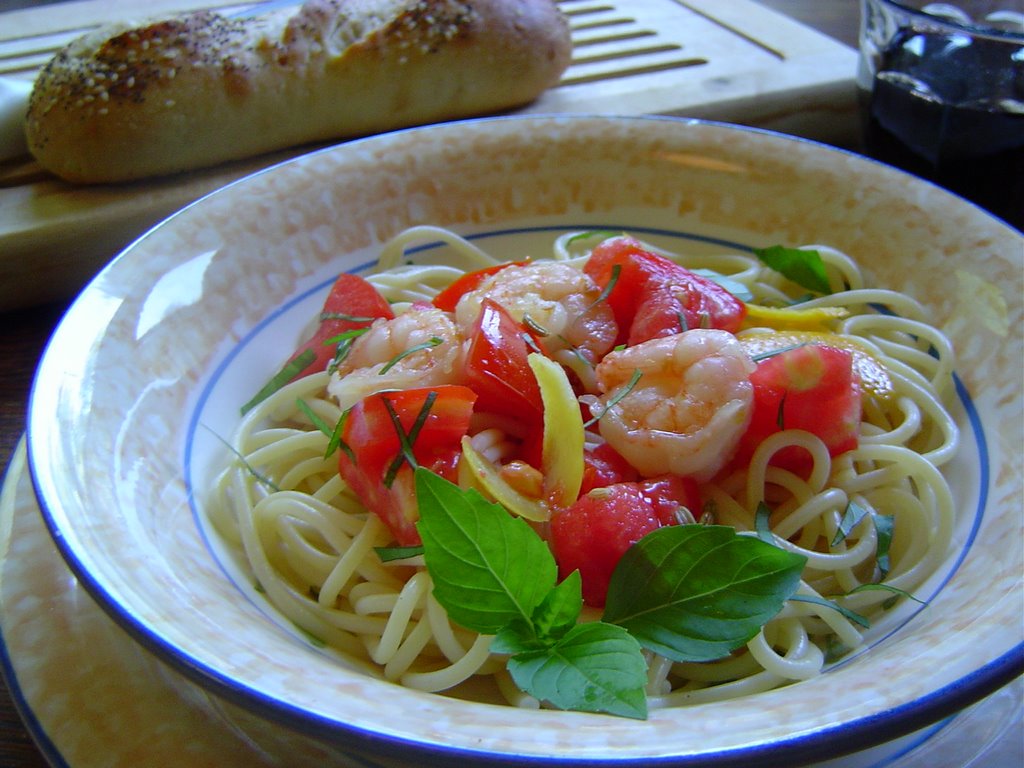
Sicilian Summer Pasta

It’s summer and the tomatoes are great right now! I love them just eaten out of hand, with a sprinkling of salt. Or sliced, sprinkled with fresh basil and drizzled with balsamic vinegar and a good green fruity olive oil. Or sprinkled with herbs and olive oil and run under the broiler for a moment or two.

And I love them in a fresh tomato sauce, which I had every intention of making for the "Presto Pasta Night Roundup." That’s the one with diced red ripe tomatoes, slivered fresh basil or oregano, diced red onion, a bit of minced garlic, capers, olive oil and a drizzle of either lemon juice or balsamic vinegar. Let it set at room temperature, loosely covered, for the better part of the day, and at dinner time, cook pasta (angel hair is the traditional one to use), toss it, still hot, with the room temperature sauce and some shredded Fontina cheese and enjoy.

I was going to make that, until I came across this in an old edition of Gourmet Magazine, speaking of the multi-starred French chef, Michel Troigros: "…(he) does cold spaghetti with poutargue (pressed tuna roe) in a sweet tomato vinaigrette…" It reminded me of a dish I had in a Sicilian restaurant in Rome several years back, and now is the perfect time to make it.

The cuisine of Sicily uses more "exotic" spices than most Italian food because of the various Mediterranean cultures that have passed through this island at the tip of the mainland "boot." And citrus fruit practically grows wild there. Anyway, I loved the dish and came home and played with it until I got close. Poutargue (or botarga, as it is known in Italy) is not readily available here—and besides it’s expensive and definitely an acquired taste--but seared shrimp make a perfect substitute.

Here’s the menu: A big salad of crisp mixed greens with chunks of peeled seeded cucumber, slivered red onion, black olives, shavings of pecarino romano cheese and a red wine vinaigrette dressing, Sicilian marinated tomato pasta, a loaf of crusty bread and for dessert, store-bought pastry shells topped with jarred lemon curd and berries. Almost everything can be done well in advance, giving you time to enjoy a nice glass of mint iced tea with your friends. How easy could it be?

SICILIAN MARINATED TOMATO PASTA

For the sauce:
1/4 cup sugar
1/4 cup water
1 piece fresh ginger, peeled, about 1" square, minced
1 tbsp whole coriander seeds
1 tsp fennel seeds, lightly crushed
1 whole clove, lightly crushed
1 orange
1 lemon
1 pint baby plum tomatoes or grape tomatoes, halved, or 1-1/4 lb tomatoes, cored and cut into chunks
To serve:
12 oz spaghetti, preferably imported
1/2 cup good extra-virgin olive oil
1 lb medium shrimp, peeled and deveined
1 large clove garlic, very finely minced
12 large leaves basil
The juice of the lemon
The juice of 1/2 the orange

Early in the morning, or even the night before, make the sauce: Dissolve the sugar in the water. Add the ginger, spices and the zest of the orange and lemon, taken off in strips with a vegetable peeler. Add the juice of half the orange. Bring to a boil, remove from the heat and reserve. Put the tomatoes in a glass or ceramic bowl and pour the syrup over the top. Let marinate, covered, up to 8 hours at room temperature, or chill up to overnight. Remove from the fridge to come to room temperature before serving.

When ready to serve, cook the spaghetti in plenty of well-salted boiling water until just barely al dente. Drain, mix with two tablespoons of the olive oil and reserve. Meanwhile, heat half the olive oil in a skillet with the garlic. Cook the shrimp until just barely pink, 2-3 minutes. Lift the tomatoes from the syrup and place in a large warmed serving bowl. Add the rest of the olive oil, a spoonful or two of the syrup (leaving the spices behind) and the lemon and orange juices. Salt and pepper generously. Add the spaghetti and shrimp and toss to combine. Sprinkle with the basil leaves, torn into bits and serve at once, or let cool to room temperature. Serves four as a main course.

Saturday, August 04, 2007

Cooling summer soups

 Lordie, isn’t it hot? And there’s nothing better on a hot summer evening than dinner with a cool salad main course. But it can be tough, if you’re entertaining, to come up with an appropriate first course when salad is the dinner. Personally, I love a cold soup in the summer. For some it takes a bit of getting used to; I have friends who think the only good soup is a hot soup! But I think if you try it, you’ll agree that it’s a refreshing and delicious first course.

I’ve chosen two soups with the nuevo latino influence I've been sort of stuck on lately. Neither takes any cooking and either can be prepared in a jiffy with the aid of a food processor or blender. Whip them up in the morning, or even the night before, so they can chill well. Or just keep them in the fridge for a quick refreshing pick-me-up when you come in from the heat!

WATERMELON GAZPACHO

8 cups diced, seeded watermelon (from half a large melon)
½ cup almond meal*
4 cloves garlic, minced
4 slices firm white bread, torn into chunks
3 tbsp red wine vinegar
3 tbsp fresh lime juice
1 tbsp kosher or coarse sea salt
Fresh ground black pepper, to taste
½ cup extra-virgin olive oil
½ cup cilantro, for garnish
Lime wedges, for garnish

Reserve one cup of the diced watermelon. Purée remaining melon with almond flour, garlic and bread. Blend until smooth. Add vinegar, lime juice, salt and a couple of grindings of pepper. With the processor on, add the olive oil in a thin stream, blending until smooth. You may have to do this in two batches. Pour into a glass or ceramic bowl and stir in reserved melon dice. Chill well. Serve in wine or martini glasses rimmed with salt (add a little chili powder to the salt if you like). Sprinkle with the cilantro and garnish each serving with a lime wedge. Serves 6-8 as a first course soup.

*Available at gourmet markets and most natural food stores

CANTALOUPE GAZPACHO

1 large cantaloupe, peeled, seeded and diced
½ to 1 jalapeño, with seeds and veins removed, diced
1 cup water
1/3 cup light rum (optional)
Juice and zest of two large limes
1 tbsp minced cilantro, plus more for garnish

Place all ingredients except lime zest and cilantro garnish in a blender or food processor and process until smooth. Transfer to a glass or ceramic bowl. Stir in lime zest and refrigerate covered until very cold. Serve in wine glasses, or flat soup plates, sprinkled with additional finely minced cilantro. Serves 6-8 as a first course soup.
Posted by Picasa

Spain Hosts Giant Tomato Fight!

Each year in the small Spanish town of Bunyol, on the last Wednesday in August, the world's largest tomato fight takes place.

Begun in 1945, some 250,000 pounds of tomatoes are smashed, trashed and tossed about. You can read more about it here.

So, I'm just thinking, do you think we could up the tourism in Ripley this way? But wouldn't it be a shame to waste all those tomatoes, which I find better than usual this year, by the way.

Friday, August 03, 2007

Video Tour of Chocolate Heaven


I've been roundly chastised for not sharing things I find online that I really like. I know I used to "blog" a lot more, but then I used to have more time to do it!

Chocolate is the new hot health item. We sell an incredible amount of dark chocolate at Mantias. Everyone thinks they're being so virtuous...it IS good for you, you know!

I ran across a series on Epicurious.com of videos from Jacques Torres, Chocolatier Extraordinaire, giving lots of information (maybe more than you want) about chocolate. And he's pretty cute, too!

Fine Diner to Riffraff: Tipsy Tales of 4-Star Benders

Somehow this seems more suitable for the National Inquirer than the New York Times! Stories of tipsy customers at some of the very finest New York City restaurants! !

Monday, July 30, 2007

Curried Turkey Meatballs

 
Posted by Picasa
I have a friend who is obliged for medical reasons to cut way down on fat intake. Trying to come up with something that would be very flavorful, but still low-fat, I happened across a curry recipe in the Sunday New York Times Magazine on April 15. The recipe as printed was for curried oysters, which didn’t ring my chimes, but the sauce sounded good and, even better, easy. I did make a few changes to suit my taste and what I had on hand.

I thought I might do it with chicken breasts, which I still think would be good, but at the meat department, right beside the chicken, was ground turkey. It comes in both white meat and mixed white and dark. I figured the white meat would be much lower in fat, so that’s what I used. I echoed some of the seasonings I used in the sauce to make turkey meatballs. To keep the fat low, I used only the white of the egg, and baked the meatballs instead of frying them.

We had it over steamed jasmine rice, with a green salad, and everyone went home happy!

Meatballs:

1 egg white, lightly beaten
1/2 cup green onion, with 2” of the tops, minced
1 tablespoon minced cilantro
1/2 cup soft breadcrumbs
1 teaspoon curry powder
1/2 tsp ground ginger
1/2 teaspoon salt
1 lb ground turkey breast

Sauce:

2 tablespoons unsalted butter
1/2 cup onion, finely minced
2 cloves garlic, finely minced
1 serrano pepper, seeded and minced (See note)
1 Granny Smith apple, peeled, cored and diced
1 tablespoon curry powder
1 teaspoon ground ginger
1 pinch ground cloves
1 pinch ground cinnamon
1 bay leaf
1 can (14 oz) light coconut milk
1/2 to 1 cup chicken stock
Juice and zest of one lime
1/4 cup cilantro, minced

Make the meatballs: Preheat oven to 350 o. Mix all ingredients in a large bowl. Form into 12 meatballs. Spray a baking sheet with cooking spray and arrange the meatballs in it. Bake until done through, about 1/2 hour.

Make the sauce: In a Dutch oven, over medium heat, melt the butter. Sauté the onion, garlic and serrano pepper until soft and translucent, about 5 minutes. Add the apple cubes, curry powder, ginger, cloves, cinnamon and bay leaf and stir a few times. Add the coconut milk and 1/2 cup stock.

Bring to a simmer and add the meatballs. Simmer for about 10 minutes, adding more stock to bring the sauce to your desired thickness. Add the lime zest and juice and simmer briefly. Serve over rice, sprinkled with cilantro. Serves 4.

NOTE: Leaving the pepper seeds in makes for a hotter curry. If you like, you may omit the pepper completely; it will still be quite tasty.

Wednesday, July 25, 2007

Summer in the South of France

 
Posted by Picasa
A while back, I was once again the guest of my friends Reed Malkin and Diane Benson for a small dinner party. Well, actually small refers only to the guest list, because when you’ve been to their house for dinner, you never go home hungry.

The dinner was inspired by the cuisine of Provence, in the South of France. Our apéritif was served outside, and was a perfect way to start a Southern French dinner: vin d’orange and gougères, a sort of savory cheese puff filled with black olives, anchovies and sundried tomatoes.

They had brought the wine back from a trip to Provence, but I remembered that the mother of one of my French friends used to make her own and had given me her recipe. And it occurs to me that if you start now, you can have a wonderful beverage to bestow upon special friends during the holiday season!

Recipes for the wine vary widely but most call for “bitter oranges,” which, to my knowledge, are not available locally. You can remedy this by adding the peel of one lime. Use the thin-skinned oranges, not the thick-skinned navel oranges. Wash them well before proceeding.

Some recipes call for a dry rose instead of the white. Some call for a stick of cinnamon to be added to the mixture. It’s your call on both.

The cheese puffs can be made a bit ahead and reheated, so they are a perfect way to start a meal that might require a lot of your attention.

VIN D’ORANGE

Peels from 10 oranges, left overnight to dry slightly
Peels from one lime, left overnight to dry slightly
8 cups dry fruity white wine (Sauvignon Blanc or Semillon works nicely)
2 cups sugar
2 cups vodka
1 vanilla bean

Mix everything in a large glass or ceramic container. Cover and store in a dark cool place for about a month, stirring every day for the first week, then occasionally thereafter. At the end of the month, strain the wine through several thicknesses of cheesecloth. Fill small bottles and cork or cap them. Let set in a cool spot for at least another month before opening. Serve well chilled. Makes about six 375 ml. (about 8 ounce) bottles.

GOUGERES DU MIDI

Pastry:
1 cup all purpose flour
1 cup water
5 tablespoons butter, cut into small chunks
1 generous pinch of salt
4 eggs

1/4 cup Gruyère cheese, shredded
4 anchovy filets, drained and finely minced
1 tbsp finely minced black olives
3 oil-packed sundried tomatoes, drained and finely minced
1 clove garlic, very finely minced

Preheat the oven to 400 degrees. Line two baking sheets with parchment paper.
Sift the flour and set aside. In a deep saucepan, place the water, butter and salt. Bring to a boil over high heat. Reduce the heat to medium and add the flour all at once, stirring quickly to avoid lumps. Continue stirring until the mixture forms a ball that pulls away from the sides of the pan, scraping into the corners of the pan. Transfer to a bowl and let cool for 8 to 10 minutes.

Add the eggs one at a time, stirring briskly to blend completely before adding the next. Fold in the remaining ingredients. Using a spoon to help form them, make balls about 1” in diameter and space them 2” apart on the baking sheets.

Bake in the center of the oven until golden brown, about 20 minutes. Turn off the oven, open the oven door and let the puffs remain in the oven for 10 minutes. Remove from the oven and serve immediately.

If preparing a bit ahead, cool on racks, then place back on parchment covered baking sheet to reheat. Makes about 30 puffs.

Tuesday, July 17, 2007

Summer white wines!

I was brousing in Fredric Koeppel's wine blog and found his list of favorite white wines for summer. I can't wait to go to my corner wine shop to see which ones are available in Memphis!

Vegetable Shepherd's Pie?

 I was at a business networking luncheon not long ago. In the post-meeting mingling, a friend mentioned that her daughter had recently become a vegetarian and she just didn’t know how to cook for her.

That seems to be pretty popular among young folks nowadays, who don’t always consider the necessity of planning healthy balanced meals. A vegetarian diet can be a healthy one, but I had one young employee who thought a lot of salads and the occasional cheese pizza would sustain her. She wound up one sick little lady.

If you are a regular reader of my columns, you know I’m definitely not a vegetarian, but I thought it was an interesting challenge.

There’s a dish in France called “hachis parmentier.” It’s sort of the equivalent of shepherd’s pie: seasoned chopped meat topped with mashed potatoes and baked. In France anything “parmentier” involves potatoes. You may remember the salmon parmentier we did a few months back (and wasn’t that a yummy dish!).

That seemed to be a good starting place. I sautéed some vegetables, and added quinoa. It’s an ancient grain that is very nourishing and adapts to a lot of different cuisines. As a bonus it has a nice little mouth crunch.

So I tossed the vegetable-quinoa mixture into a casserole and topped it with seasoned mashed potatoes. It looks like a long recipe, but it goes very quickly. It was totally an experiment, and with a tossed salad with some feta cheese and toasted pine nuts included, made a lovely meal.

Not one of the Monday night tasting group asked “Where’s the meat?!?!”

PARMENTIER AUX LEGUMES

For the bottom layer:
1/2 cup quinoa
2 medium carrots, peeled and very thinly sliced
1/4 cup good fruity olive oil
2 cloves garlic, minced
1 medium red onion, coarsely chopped
3 stalks celery, thinly sliced
1 red bell pepper, seeded and diced
2 cups cabbage, finely shredded
2 small zucchini, thinly sliced
1 bunch fresh kale or spinach, stalks removed, shredded
1 can diced tomatoes, with Italian seasoning

For the top layer:
2 lbs russet or Yukon gold potatoes, peeled and coarsely chopped
1 medium carrot, peeled and shredded or finely chopped
1/4 cup heavy cream, crème fraîche or sour cream
Salt and pepper to taste
1/2 cup fine dried bread crumbs
1/2 cup freshly grated parmesan, asiago or gruyère cheese
2 tablespoons minced parsley

In a medium saucepan, simmer the quinoa in 1 cup lightly salted water until tender. This will take 15-20 minutes. It should absorb pretty much all the liquid. Add the sliced carrot after about 10 minutes. Set aside.

In a large skillet, heat the oil. Add the garlic, stir a couple of times, then add the onion, celery, bell pepper and cabbage. Sauté, stirring occasionally, until just barely tender, about 10 minutes. Add the zucchini and kale and continue to cook, stirring frequently, another five minutes. Remove from the heat. Stir in the quinoa-carrot mixture and turn into a casserole greased with olive oil. Scatter the tomatoes and their liquid over the top.

Meanwhile, in a large pan of well-salted boiling water, cook the potatoes and carrot until tender, about 20 minutes. Drain well and mash together. Add the cream, and season to taste.

Spread on top of the vegetable mixture, making sure to completely cover all the way to the edges. Mix together the crumbs, cheese and parsley and sprinkle evenly over the top.

Bake in a preheated 350-degree oven until heated through and the top is golden, about 30 minutes. If you want a crispier top crust, you could run it under the broiler for a few minutes. Serves 6 to 8.

NOTES: 1) You can make this ahead and leave out, covered, for an hour or two. Or do it up to a day ahead and chill, but bring out of the fridge at least an hour before baking.

2) If you would rather not buy a whole cabbage and shred it, you could use bagged cole slaw mix from the produce section. That’s what I did.

3) I think I would love this with diced roasted butternut squash in place of the zucchini. Or beets.
Posted by Picasa