Wednesday, December 20, 2006

Weekend Brunch for a Bunch

  I grew up in Louisville, where there are two holiday seasons: the month of December and the couple of weeks leading to Derby Day, the first Saturday in May. Both are a whirl of parties and entertaining. The trick for both was to plan your party so you would have the most people come, and your wouldn’t miss a really good one given by someone else.

As a young bride, I found a solution that worked best for me. I tended to be a bit more moderate in my fun-having than some. So my traditional party was a brunch, the Sunday after Derby Day in May, and on New Year’s Day in January. Everyone came, since I was the only one entertaining on those days, and all appreciated not having to cope with getting breakfast together themselves.

The trick to this is to have dishes that can be mostly prepared in advance. Recently a group of friends got together for a leisurely brunch. We set out a platter of assorted cheeses and crackers to start. The main event was a made-ahead mushroom-cheddar sauce with hard-cooked eggs and Canadian bacon on toasted English muffins and served with a salad. For a sweet, we had an easy lemon coffeecake from a recipe I’ve had for a while. It probably came off the back of a Bisquick box.


The last minute work on this is minimal. The day before, make your sauce, cook your eggs and make your cake. Then for the brunch. all you have to do is reheat the sauce and add the eggs, warm the Canadian bacon and toast the muffins. Toss a bag of spring greens with a small can of Mandarin oranges (drained), sliced strawberries and purchased poppy seed dressing. Make a big pot of coffee. Set out pitchers of orange and tomato juices with bottles of vodka and sparkling wine if that’s your inclination.

We made a sort of Kir Royal with champagne and pomegranate juice (available in the produce section of most supermarkets). It was an experiment and a felicitous one, since it wasn’t too sweet.

Why don’t you start your own New Year’s Day tradition? Invite your friends, feed them and then let them put their feet up to watch the football games, work the crossword puzzle or just nap a bit. They’ll be so grateful!

Mushroom-Cheddar Brunch Muffins

1 lb white mushrooms, divided
8 tbsp unsalted butter (one stick), divided
6 tbsp all-purpose flour
2 cups chicken or vegetable stock
1 cup half-and-half
1 tsp each dry mustard and sugar
1 tbsp Worcestershire sauce
1/2 cup dry sherry
12 ounces sharp cheddar, shredded
1/2 small onion
1 cup sliced black olives
1 jar (12-ounce) roasted red peppers, drained and sliced
24 slices Canadian bacon
12 English muffins
12 eggs, hard cooked, peeled
Sweet paprika, for garnish

Slice about half the mushrooms. In a large saucepan or Dutch oven, heat 2 tablespoons of the butter and sauté the sliced mushrooms over medium heat until lightly browned. Remove with a slotted spoon and set aside. Add the remaining butter to the pan. When it starts to foam, whisk in the flour and cook, stirring constantly for a couple of minutes. Whisk in the stock until smooth, then whisk in the cream. Add the mustard, sugar, Worcestershire sauce and sherry. Cook over low heat, stirring occasionally, until thickened.

Meanwhile in a food processor, combine the remaining mushrooms and the onion and pulse to make fine “crumbs.” When the sauce is smooth and thick, add this mixture and continue to simmer for about five minutes, stirring often. Add the reserved sautéed mushrooms, the olives and the roasted peppers. Stir in the cheese until melted. At this point you can cover, cool and refrigerate until ready to use, up to three days.

When ready to serve, peel and slice the eggs. Warm the sauce and gently stir in the eggs. Split the muffins and place on a baking sheet. Put the slices on Canadian bacon on another sheet. Preheat the broiler. Place the Canadian bacon on a lower shelf with the muffins above. Toast the muffins, watching carefully (they go from toasted to charred very quickly!). On dinner plates, place two muffin halves, top each with a warmed Canadian bacon slice, then the sauce. Sprinkle with paprika and serve immediately.

You can also put the sauce in a chafing dish, set out the muffins and Canadian bacon, and let folks serve themselves as they wander in. Serves 12.


Bisquick Lemon Coffee Cake

2-1/2 cups Bisquick baking mix
1/2 cup sugar
1 tsp poppy seeds
1 lemon (peel and all) warmed, seeded and cubed
3 eggs
1/3 cup butter, softened
2 tbsp milk
1 cup powdered sugar
5 tbsp fresh lemon juice

Preheat oven to 350o. Stir together Bisquick, sugar and poppy seeds. In a blender or food processor blend lemon pieces until finely chopped. Add eggs and butter and blend well. Pour into dry ingredients. Add milk and stir until just moistened. Pour into a greased 9-inch cake pan. Bake for 35-40 minutes, until lightly browned. Cool about 15 minutes.
In a small bowl, stir together powdered sugar and lemon juice. Drizzle over the cake. To store, let glaze set, then wrap in plastic wrap and store at room temperature. Makes 12 modest sized servings.
Posted by Picasa

Tuesday, December 12, 2006

Menu for Hope

Once a year, in a tradition started by Chez Pim, the food bloggers of this world unite for a world-wide virtual raffle in which proceeds are donated to a charitable cause. Last year's event raised over $17,000 and with the number of foodblogs and their audience having at least tripled in the last year, we are hoping to raise even more this time round.

And here's how it works: many participating foodbloggers donate a prize which is advertised on various Menu for Hope portals around the world. From there on it's over to you, really!

Readers can buy raffle tickets for just $10 each on a secure website, specifying which prize (or prizes) they'd like to win. The more tickets they buy, the more chances of winning, obviously. Winners will be announced on Chez Pim on the 15th of January and your prize will be shipped at no cost to you. All proceeds will be donated to the United Nations' World Food Programme - no foodblogger will ever touch the money collected, it will go straight to the UN.

Take your pick of prizes: wine and cheese from Sonoma County? Chef's knives? Perhaps you'd rather have gourmet olive oils or European food baskets?

Then go to the donation page and donate to support the fight against world hunger and for a chance to win one of hundreds of prizes!

Wednesday, December 06, 2006

Pastitsio--Greek Baked Pasta

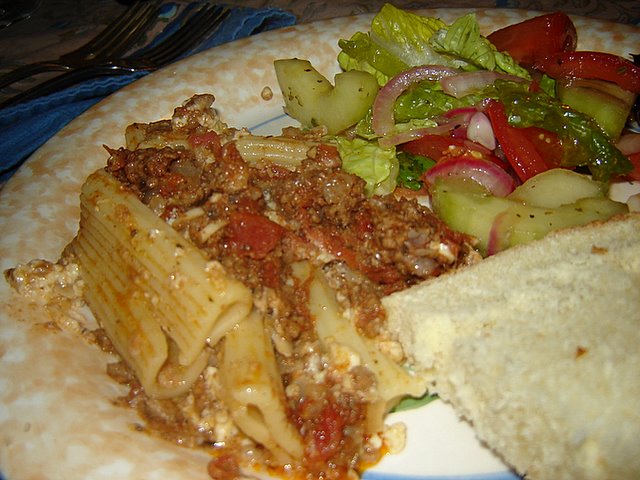
 Finally! We got weather that really said “It’s winter!!!” And there’s almost nothing that I like better when it’s really cold outside, than a good baked pasta dish. The Greeks have a good one, pastitsio, that is among my favorites.

Recently I made this for a group of friends. Earlier in the day I peeled and seeded cucumbers, sliced red onion very thinly and cut up a couple of tomatoes that looked surprisingly appealing for winter tomatoes. I covered them with a vinaigrette made of red wine vinegar, olive oil and dried oregano and left them sitting on the kitchen counter. When I would think about it, I gave them a little toss. By dinnertime they were ready to put on top of a bed of lettuce for a salad that made a perfect complement to the pasta.

I want to encourage you to make the sauce at least a day ahead and refrigerate it, so the fat can be taken off the top once it is cold. If that’s not possible, just skim off as much fat as you can once the sauce is done.

If you are one of those people who think they don’t like lamb, I would like to encourage you to try this. If you are absolutely sure you don’t like lamb, you can use lean ground beef instead. Either way, it will make you feel warm and toasty when the weather outside is not!

PASTITSIO

3 tbsp olive oil
1 large onion, chopped
6 large cloves garlic
1 lb ground lamb
1 tsp each oregano, cinnamon, and ground cumin
1/2 tsp each ground ginger and ground coriander
2 bay leaves
1 cup dry red wine
2 tbsp tomato paste
2 cans Italian herb diced tomatoes, undrained
TOPPING:
1/2 cup butter
2 cloves garlic, minced
1/4 cup flour
4 cups milk
1/2 tsp salt
1/8 tsp nutmeg, freshly grated
TO FINISH:
1 cup parmesan, freshly grated
1 lb rigatoni
4 eggs

Make the sauce: In a medium saucepan, heat the oil and cook the onion and garlic until soft and translucent. Add the lamb and cook, stirring frequently, until the meat is cooked through and crumbly. Stir in the herbs and spices and cook, stirring, another 5 minutes. Dissolve the tomato paste in the wine and add with the tomatoes. Cover and simmer gently for 30 minutes. Uncover and cook until thickened, another 30 minutes or so. Cool, cover and refrigerate.

Preheat your oven to 350. Cook the pasta according to package directions until just barely tender. Drain well.

Meanwhile make the topping: In a saucepan, cook the garlic in the butter over very low heat for about 3 minutes. Whisk in the flour and cook, stirring constantly, for about 5 minutes. Don’t let it brown. Slowly whisk in the milk, Stir in the salt and nutmeg. Bring to a boil, whisking to avoid lumps, and simmer gently for about 10 minutes. Remove from the heat and stir in one cup of the grated cheese.
Warm the lamb sauce gently. Separate two of the eggs. Whisk the whites until frothy and stir into the lamb sauce. Toss with the cooked pasta. Pour into a four-quart baking dish.

Add the remaining two eggs to the two yolks and whisk to blend well. Stir into the topping. Pour evenly over the pasta and sprinkle the remaining parmesan cheese over the top. Bake in the middle of the oven until golden brown, about 45 minutes. Let cool about 15 minutes before serving. Serves 8 very generously. Posted by Picasa

Friday, December 01, 2006

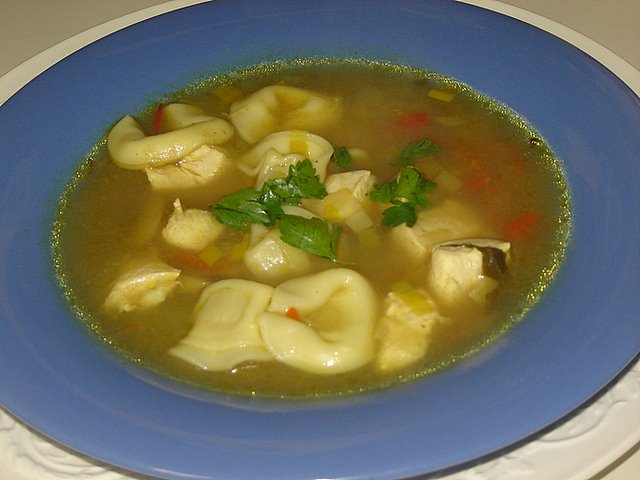
Chicken Tortelloni Soup

  After several days of unusually warm weather, winter has arrived! At least we missed the worst of the winter storm, but it's still pretty nippy out there...a perfect day for soup!

There have been some studies done that indicate that folks who either start their dinners with soup, or make soup the main course, tend to eat fewer calories overall during that meal. With all the holiday parties coming, some of us (including me!) should probably be eating soup at every meal. I, for one, would be quite happy to do that.

I had some friends coming for a casual dinner recently, and running late, as usual, I didn't have time to do a lot of cooking. Fortunately I always keep some good bread in the freezer. When I bring it home, I wrap it first in foil, then put it in a plastic freezer bag. I can take it out of the freezer when I need it. It thaws fairly quickly at room temperature, and then it crisps up nicely in a hot oven. You'd never know it wasn't fresh from the bakery.

I also had all of the makings for this soup. I like using the fresh stuffed pastas--ravioli, borsellini (little purses), tortellini (modeled, by legend, from the navel of Venus)--that you find in the refrigerated section of all the supermarkets now. There is a great variety with all kinds of interesting fillings. They freeze well, too, right in their package. Usually you can cook them from the frozen state but they should be thawed before using in this particular recipe. I think you could use sausage stuffed ones in this recipe very nicely for a little variation of flavor. And I know it would be a great way to use up any holiday turkey leftovers.

With a pre-packaged bag of salad greens topped with a handful of toasted walnuts, some crumbled gorgonzola cheese and red wine vinaigrette, we had a lovely meal, This soup was declared quite tasty by everyone, so of course I must share it with you!


CHICKEN TORTELLINI SOUP

2 tbsp butter
1 cup onion, diced
3 cloves garlic, minced
2 cups white mushrooms, thickly sliced
1 tsp curry powder
1/4 tsp ground cumin
8 cups chicken stock
2 tbsp diced roasted red bell pepper or pimento
1 package fresh cheese tortellini
1 lb boneless skinless chicken breasts, cut into 1/2" cubes
Fresh cilantro or parsley, chopped, for garnish

In a large saucepan with a lid, melt the butter over medium heat. Add the onion and garlic. Cook, stirring frequently, until the onion starts to get soft and translucent. Add the mushrooms and cook, stirring, until lightly browned. Add the curry powder and ground cumin and stir well. Add the chicken stock and roasted pepper or pimento. Bring to a boil, lower heat, and simmer for about 15 minutes. You can do this ahead of time. When ready to serve, bring back to a boil. Add the tortellini and chicken cubes. Bring back to a boil, cover, remove from heat and let stand for 10 minutes. Ladle into bowls and top with minced cilantro or parsley for garnish. Serves 6 as a main course. Posted by Picasa

Tuesday, November 28, 2006

Dinner with friends

I have friends who love to cook. I have friends I love to cook with. One who fits into both categories is Laretha Randolph. She and her husband, Bryson, are like family, so when she called recently on her way into the supermarket and asked me to dinner, of course I accepted. “Come in about half an hour,” she said.

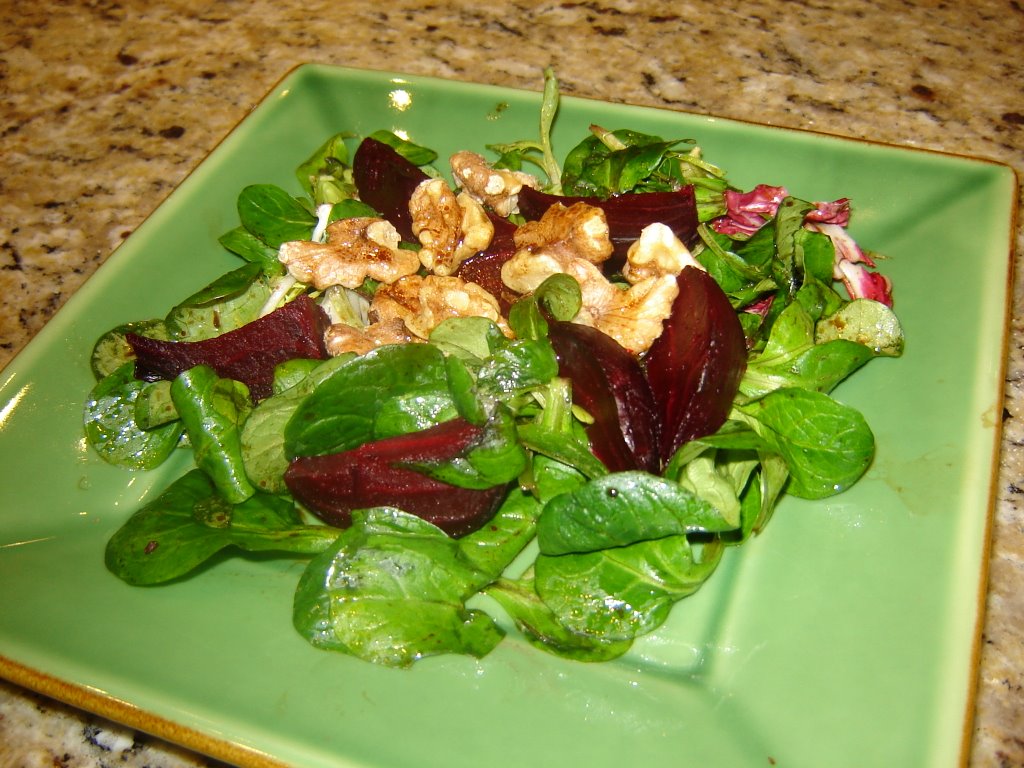
Sure, I thought…she wouldn’t even be home by then. Was I surprised! Not only was she home but also had a good start on dinner. And she put me to work, too. Baby beets were roasting in the oven. When done and cooled a bit, I peeled them and sliced them over a bed of mâche, a slightly bitter baby green. Topped with toasted walnuts and a raspberry-balsamic vinaigrette with a touch of walnut oil, our first course was done.

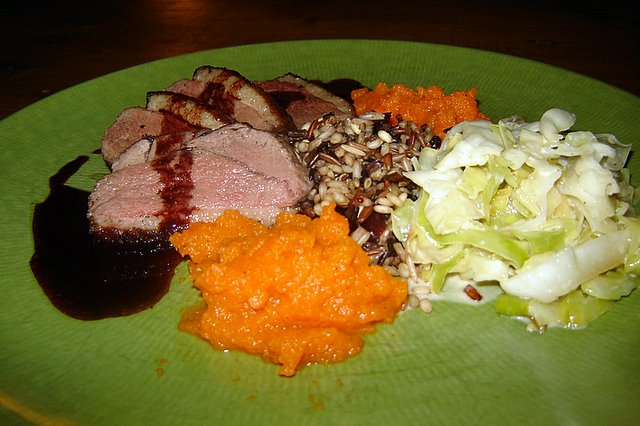
Duck breasts, dusted with salt and pepper, were searing in a very hot heavy skillet with a touch of olive oil. When nicely browned and crusty, Laretha transferred them to a baking pan to finish in the oven. A little port reduced in the skillet made a simple but very fine sauce.
 
Meanwhile, I had peeled carrots and sliced them into chicken broth seasoned with ground cardamom. Drained and mashed like potatoes, they were subtly flavored with the spice. It was a new idea for me.

A long grain-wild rice mixture was simmered with dried cranberries added.
And as if this wasn’t enough, she set me to shredding cabbage. The addition of blue cheese to the sautéed cabbage was the final touch on a very impressive dinner. And all done within about 45 minutes.

I was amazed.

You could do this, too, you know. If you’re not a fan of duck breasts, you can substitute a good cut of steak. New York strip would do nicely, I think. Whether you choose to do this whole menu or just a part of it, I know your friends will enjoy it as much as I did!

LARETHA’S STILTON CABBAGE

1/2 of a large head cabbage (you’ll use about 1 1/2 pounds)
1 tablespoon olive oil
3 ounces Stilton or other good quality blue cheese, crumbled
1/4 cup heavy cream
1/4 tsp each salt and fresh ground pepper (or to taste)

Cut the head of cabbage in half from top to stem. Turn it with one cut side down and cut into 1/4” shreds. In a heavy skillet, heat the olive oil over medium heat. Add the cabbage and sauté, stirring occasionally, until crisp-tender, about 6 minutes. Add the crumbled Stilton and stir a couple of times. Add the cream. Reduce the heat, cover and simmer for a minute or two, until cheese has melted and sauce begins to thicken. Add salt and pepper to taste. Serves 6. Posted by Picasa

Friday, November 24, 2006

Winter squash: wonderful!

  I certainly hope everyone had as great a holiday dinner as I did! As always, I spent the day at the home of good friends. I try to get there a little early to help. And I always take this squash casserole. The original recipe came from the New York Times magazine in 1999, and I love it.

The topping has black walnuts and bacon. Black walnuts may be a bit hard to find, but it's worth looking for, since the flavor is very different from English walnuts. I found them this year at Schnucks; Kroger does not carry them. I bought several packages for the freezer as well, since I think they are the only nuts to use in my Aunt Mary Lee's blackberry jam cake.

I've made this a time or two for non-meat eaters, and used melted butter in the topping rather than the bacon and bacon fat. It is equally tasty.

You can assemble it ahead of time and refrigerate the casserole and the topping mixture separately, then sprinkle on the topping and bake when you're ready for it.

Give it a try!


BUTTERNUT SQUASH WITH BLACK WALNUT CRISP

2 small butternut squash, about 2# each (or one large one)
1 red onion; peeled and thinly sliced
3/4 cup heavy cream
1-1/2 cups fontina, grated
2 teaspoons kosher salt
1/2 teaspoons freshly ground black epper
4 tablespoons fresh parsley, chopped
6 slices bacon, a good smoked kind, diced
1 cup black walnuts, chopped
1 cup fresh bread crumbs

Preheat the oven to 375.

Peel the squash (a vegetable peeler works best) and cut in half. Scoop out the seeds and scrape out the fibrous part. Cut into 1/2" dice. In a large bowl, toss the squashes, onion, cream, cheese, salt, pepper and half the parsley. Scrape into a gratin dish or baking dish. Set aside.

In a skillet set over medium heat, cook the bacon, stirring, until browned and crisp. Add the walnuts and cook, stirring, until lightly toasted. Add the breadcrumbs and cook for another minute. Remove from the heat and stir in the remaining parsley. Sprinkle the mixture evenly over the casserole. Bake until the squash is very tender and the topping is browned, about 45 minutes. Allow to cool slightly before serving. Serves 8. Posted by Picasa

Friday, November 17, 2006

Raclette for a Winter Treat!

  It is time for some winter comfort food. Before the big rush of the holidays, we just want to have a casual dinner with a few friends. One thing that comes to my mind when the cold weather hits is raclette. Raclette is the name of a cheese, and the name of a dish made with it. The name comes from the French verb “racler,” which means “to scrape,” which is what you do to the cheese as it melts.

Although there are a couple of stories about the origins of the dish, the place of the origin is not disputed: first in the Swiss Alps in the canton of Valais, spreading to the French Alps in the Savoie region. Depending on which legend you believe, it was created by shepherds taking their meal of bread, some cold potatoes and cheese that they heated over the fire they had built to keep warm in the fields. Or it was first cooked by grape harvesters taking a break from their tiring work. One of them stabbed his cheese with a knife and held it up to the fire to warm, scraping off the melting cheese.

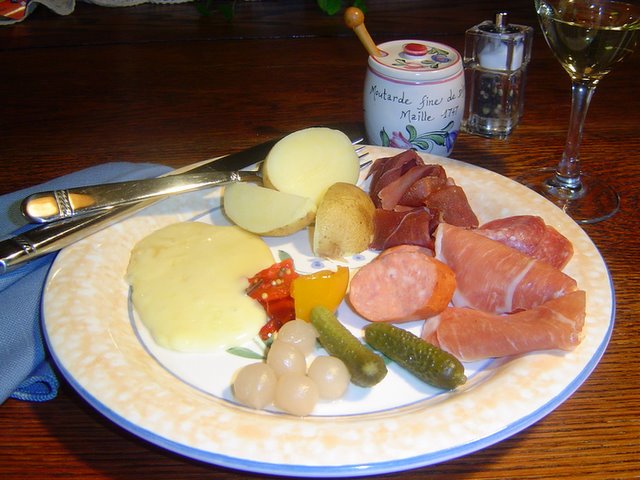
My sister Cindy, who teaches French in Knoxville, introduced me to raclette. Several years ago, she went to study in Annecy, in the French Alps, about 20 miles from Switzerland. One of her favorite restaurants had all-you-can-eat raclette one night a week during the winter. There would be a big wheel of raclette cheese near the fireplace just melting enough to get soft. The waiter would scrape off the cheese onto small warmed plates, and would bring you as many platefuls as you wanted. Cornichons (French sour pickles) and pickled onions would be in jars on the table. Also on the table would be boiled potatoes wrapped in towels to keep them warm and a platter of sausages and ham. According to her, before you realized it you had eaten WAY too much, but it was SO good!

I had never had it, since I had usually gone to France in warmer weather, and spent most of my time in the south, rather than in the mountains. Then for Christmas a few years ago she got a raclette machine. It has eight little individual pans that slide in under a heating element. The top can be used to heat the sausage, ham or salami. There’s another type that holds a full half wheel under a heating element, so that each person can scrape off what he wants. Both are pretty pricey unless you plan on using them a good bit. I was fortunate enough to find a brand new one for myself at an estate sale, a real bargain. But if you don’t have one of these machines you can still enjoy the raclette experience.

This is definitely a winter dish (think apres-ski), and one to share with a small group. If you would like to give it a try, get your raclette cheese (available at cheese shops and gourmet markets); about 8 ounces per person should do it. The cheese itself is a full flavored cheese, very aromatic but not strong and smelly. If you can’t find raclette, Appenzeller or Gruyere would be almost as good.

Here’s the plan: Boil small unpeeled redskin or Yukon Gold potatoes and keep them warm. On a platter, arrange the sliced meats: ham, prosciutto, salami, smoked and fresh sausages. Put out bowls of cornichons and pickled onions and a loaf of crusty bread. Optional (and definitely not traditional) are slices of tomato, steamed broccoli florets, slices of red bell pepper and sautéed mushrooms. You might want a little pot of Dijon mustard, too.

Slice the cheese about 1/4” thick. In a buttered shallow baking dish that can go to the table, place one slice of cheese (rind removed) per person. Slide into the oven about 4” below a pre-heated broiler. Watch carefully and when it just starts to melt and look a bit crusty, take it out. Meanwhile your friends will have filled their plates, preferably pre-warmed, with the condiments. Scoop a slice of the cheese onto each plate and dig in. Repeat until the cheese is gone and everyone is full and happy.

The only side dish you might want is a green salad with a simple white wine vinaigrette (2 tbsp white wine vinegar, 1/2 cup olive oil, 1 teaspoon of Dijon mustard, salt and pepper to taste, whisked together).

I have a friend who makes this with a pizza stone set on the hearth right in front of the fireplace, with the cheese resting on the side with the rind. I haven’t tried this, but it would be a fun way to do it, with everyone gathered around the fire, and would lend an authentic slightly smoky flavor.

For dessert, a dish of sliced oranges, sprinkled, if you like, with slivered fresh basil and a touch of honey does the trick. If you’re more ambitious, make it a fruit salad with the addition of thinly sliced apples and pears, and sprinkle with toasted walnuts.

So who cares if the weather outside is frightful...raclette is SO delightful! Posted by Picasa

Monday, November 13, 2006

Salmon Shepherd's Pie?

In France, when you see the word parmentier on the menu, it always refers to a dish containing potatoes. It refers back to Antoine-August Parmentier, an apothecary student sent off to fight the Prussians during France’s Seven Year War (1756-1763). He was taken prisoner of war by the Prussians, and while in captivity he was fed a steady diet of potatoes—three times a day.

Returning to France he attempted to establish the potato as a culinary staple, but the French weren’t having any of that. Not, at least, until wheat crops faltered, causing a shortage of the beloved bread. It took a few years to convince the French, not until Louis XVI recognized his efforts and served the potato at court, including, the story goes, a dinner for diplomat Benjamin Franklin that featured an “all potato” menu.

Antoine started potato soup kitchens all over Paris to feed the starving citizenry, and has been rewarded by posterity by having the ubiquitous French potato-leek soup named after him.

Besides the soup, there is another dish also bearing his name: “hachis parmentier.” It resembles to a great extent what we call shepherd’s pie: a bottom layer of seasoned chopped meat, topped with mashed potatoes and baked. Comfort food, for sure!

I read, recently, in a French magazine, about a version using fish instead of meat. I figured this would lighten it considerably, and gave it a try recently with my usual Monday evening neighbor guinea pigs.

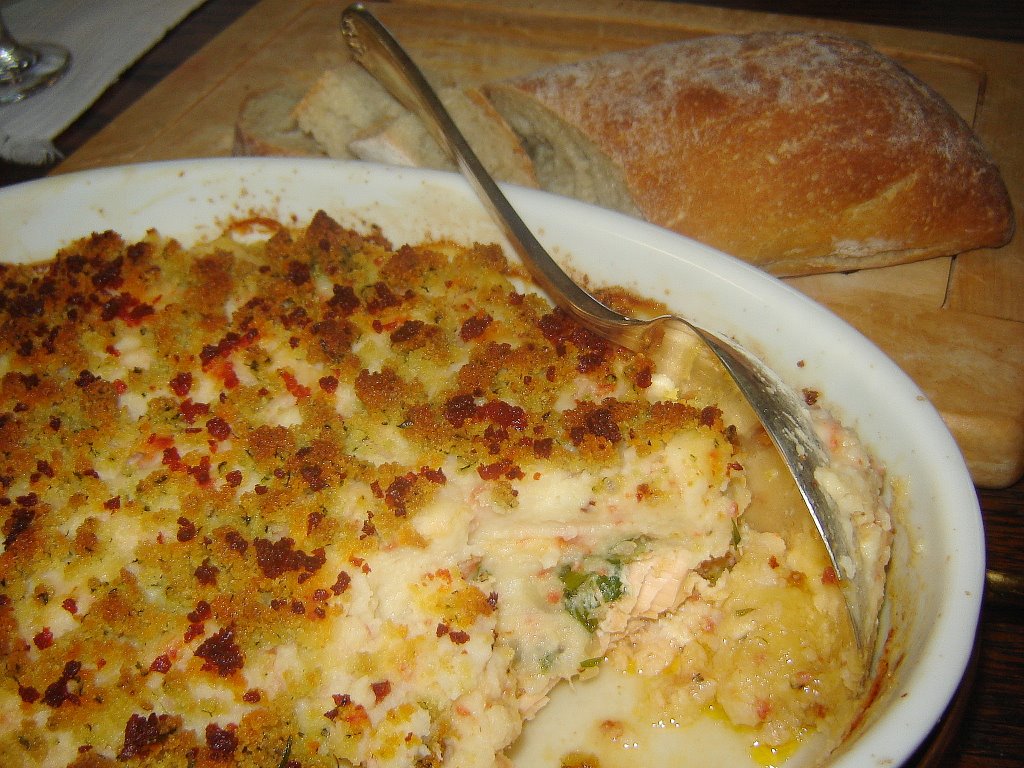
I cooked the potatoes with cauliflower and mashed them together. I had a small piece of Spanish chorizo in the fridge. I diced it and whizzed it in the food processor to make crumbs out of it, and mixed it into the potatoes. I used salmon for the base, topping it with sautéed onions and shallots, and used tarragon as the seasoning. Topped with breadcrumbs and baked, it was truly a delicious dish. I served it with just a salad with light vinaigrette and we were all happy!

PARMENTIER AU SAUMON

1 cauliflower
2 large Idaho potatoes
? pound Spanish chorizo (or substitute pepperoni)
2 cloves garlic, peeled and chopped
1 bunch green onions, thinly sliced, including green tops
2 shallots, peeled and thinly sliced
4 tablespoons olive oil
5 tablespoons fresh tarragon leaves, divided
? cup half-and-half, or whole milk
2 pounds boneless salmon filet
? cup butter
4 slices firm bread, crusts removed

Remove the green leaves from the cauliflower and cut into florets. Peel the potatoes and cut into chunks. Cook the potatoes and cauliflower in plenty of salted water for 20-25 minutes, or until tender.

Meanwhile, cook the garlic, onion and shallots in the olive oil over low heat until tender, about 15 minutes. Dice the chorizo and pulse a couple of times in a food processor, or chop very finely by hand.

Drain the potatoes and cauliflower, place in a large bowl and mash. Add the warm milk and the chorizo.

Preheat the oven to 350 F. Butter a shallow 2-quart casserole. Put the salmon, cut into slices, evenly over the bottom. Sprinkle with salt and pepper.

Top with the onion/garlic/shallot mixture. Sprinkle with half the tarragon. Spread the potato mixture evenly over the top. Put the bread in a food processor with the remaining tarragon and the butter and pulse to make crumbs. Sprinkle over the top of the casserole.

Bake for 45-50 minutes, or until the top is golden and crusty. Let set for about 10 minutes, then scoop out and serve. Serves 6-8.

Tuesday, November 07, 2006

Warming winter soup!

Every year about this time, I start looking in my closet for cool weather clothes and wonder what I wore last winter. I pull open drawers and peer into my closet looking for sweaters, warm jackets and wooly socks. I check the firewood situation in case I need to build a fire on a wet gray day. And I pull out the soup pot and think about what to cook in it.

A couple of weeks ago, we had that first chilly rainy autumn day. It was the day that my Monday dinner crowd was coming, and all I could think about was soup. I considered chili, but for that, in my mind at least, the weather needs to be really blustery and freezing cold. I headed to the market with nothing precisely in my mind, but I picked up a few items that I thought would combine well.

Well, look at what I had, a whole basket full of cruciferous vegetables: broccoli, cauliflower and cabbage! This group has been touted variously as being good for cancer prevention, anti-aging, lowering cholesterol, and making you rich (well, I made that last one up myself, wishful thinking, I’m sure).

A couple of potatoes and I was set for soup. I love potato soup and that’s where we started, then added and adjusted until it was quite tasty. I made cornbread and had a basic green salad and it made the perfect meal for a chilly fall evening.

Yummy Veggie Chowder

2 lbs russet or Idaho potatoes, peeled and cut into chunks
4 cups chicken stock
8 slices good smoked bacon, cut crosswise into 1/4” strips
2 cloves garlic, finely minced
1 large onion, cut in half from stem to root end and thinly sliced
1 red bell pepper, cut into thin strips
1/2 small head cabbage, shredded
1 16-ounce bag broccoli-cauliflower combination (from the produce section)
2 cups whole milk
Salt and pepper to taste
1 cup (about 4 ounces) shredded Jarlsberg or good Gruy?re cheese

In a medium pan, combine the potatoes and chicken stock. Bring to a boil, reduce the heat to medium and simmer until the potato is almost done.

Meanwhile, in a soup pot, cook the bacon, stirring often, until just starting to brown. Remove the bacon strips with a slotted spoon and reserve. Add the garlic to the bacon fat and stir a couple of times. Add the onion and bell pepper and cook over medium heat, stirring frequently, until the is soft and translucent.

Pour the potato mixture into the soup pot with the onions. Stir a couple of times and then add the cabbage, and the broccoli and cauliflower (cut into bite-sized pieces). Cover and simmer until the vegetables are done and the potato is very soft, about 15 minutes. Season to taste with salt and pepper. Reserve a couple of tablespoons of the cheese and blend the rest into the soup. If the soup seems too thick, add a bit more stock.

Ladle into soup bowls and top with the reserved bacon and a few shreds of the reserved cheese. Serves 8 as a main course soup.

Saturday, November 04, 2006

Volare Ristorante - Again!

You may remember my visit to Volare Ristorante in Louisville, back in August, with my sister. It is an enormous tribute that we went back a second time, considering how many great and unique restaurants in Louisville. But we couldn't resist the promise of an Umbrian dinner a couple of weeks ago.

It started with an antipasto of two kinds of sausages, both apparently made in-house, a couple of wedges of truffled cheese and a melange of olives that had been marinated in orange juice.

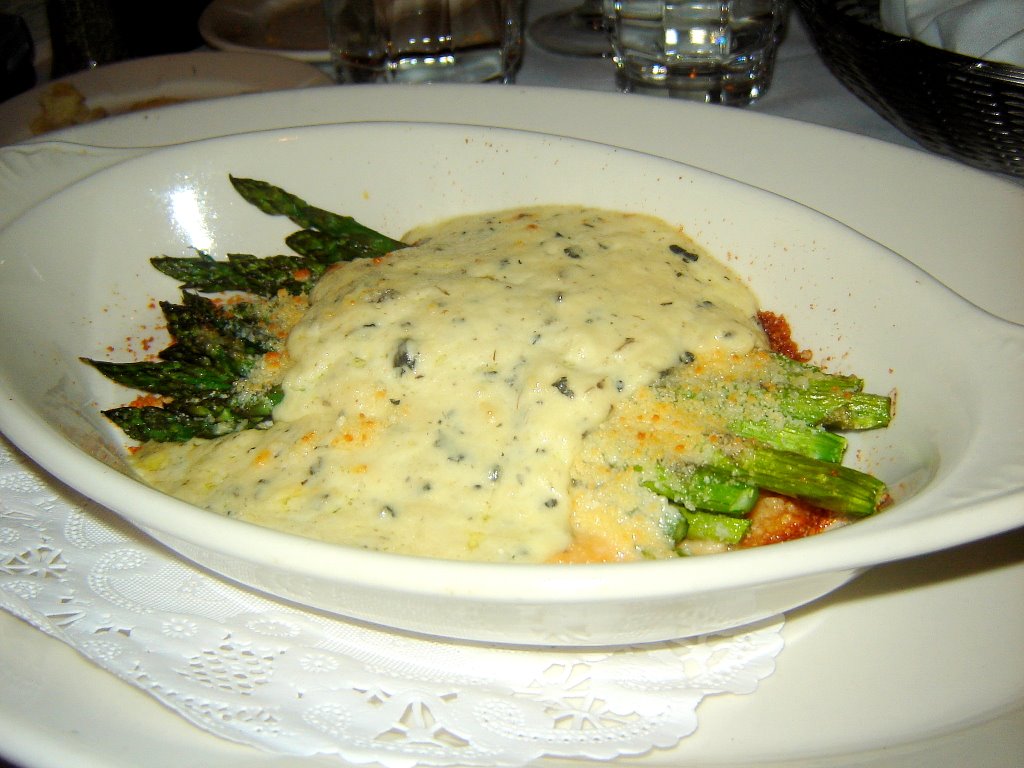
The next course was a wonderful dish of asparagus topped with salsa besamiella laced with truffles, sprinkled with grated parmesan and run under the broiler. It was a substantial dish, and I would have been delighted to be able to finish it, wiping up the last dribbles of the sauce with the excellent bread we had.

Then came the primo piatto: a wide pasta--wider than fettuccine, narrower than papardelle--tossed with a very light tomato sauce with bits of eggplant, onion and herbs. In the true Italian manner, it wasn't drenched with the sauce. It was delicious, but now we were starting to get full, and were only half way through the meal!

Our next course was a sort of intermezzo of a pear poached in sangiovese on a bed of arugula, with shavings of pecarino cheese. I would have liked a drizzle of the poaching liquid on the greens, but it was still quite tasty. This is a course I've never had in Italy, and probably, had I been orchestrating the meal, would go better after the secondo piatto, before dessert.

For the secondo piatto, we had our choice of a pork chop marinated in white wine and herbs and grilled, grilled trout, or rabbit simmered in a rich tomato-wine sauce redolent of garlic. My sister had the pork, I had the rabbit. Both were very well done.

The final course, the dolce, was a sampler: ossi dei morti ("bones of the dead," an All Saints Day traditional cookie in Italy), a slightly dry (and therefore very Italian) lemon cake, and the best, chocolate fettuccine in a creme anglaise sauce. In spite of the fact that we were by now thoroughly stuffed, we both somehow managed to put it away!

We are now planning our next trip to visit the parents for the last weekend in January, for the Tuscan meal!